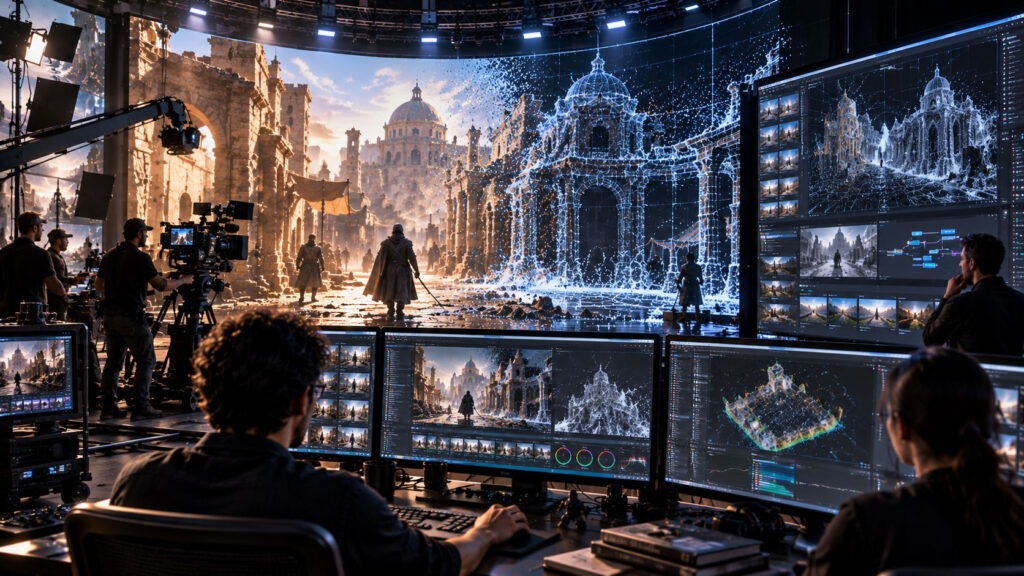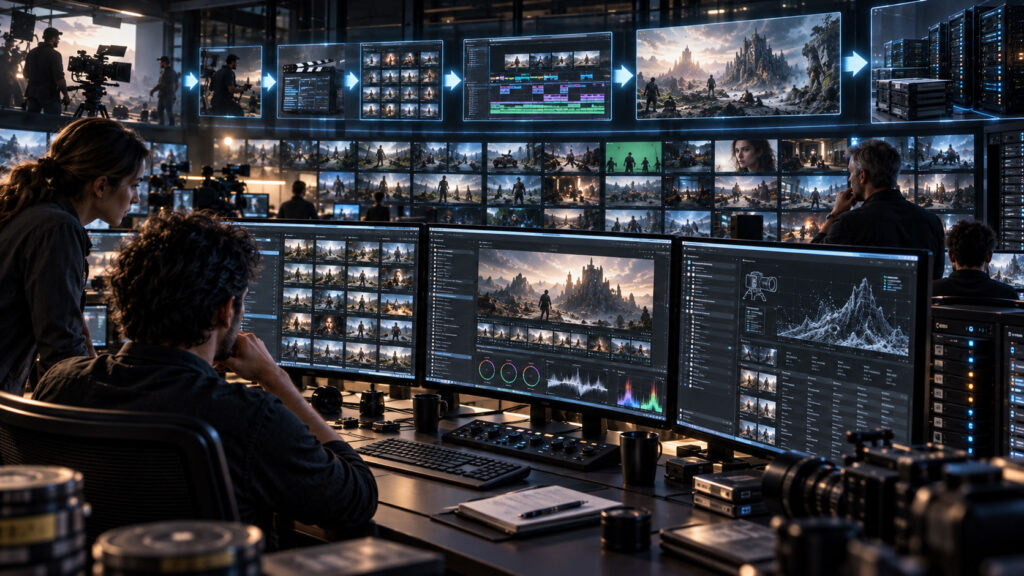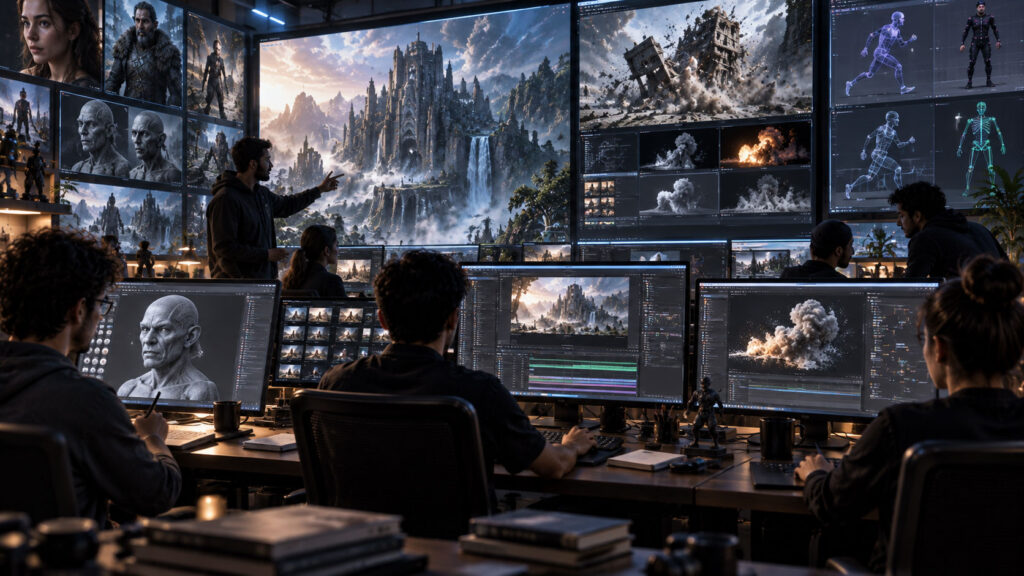
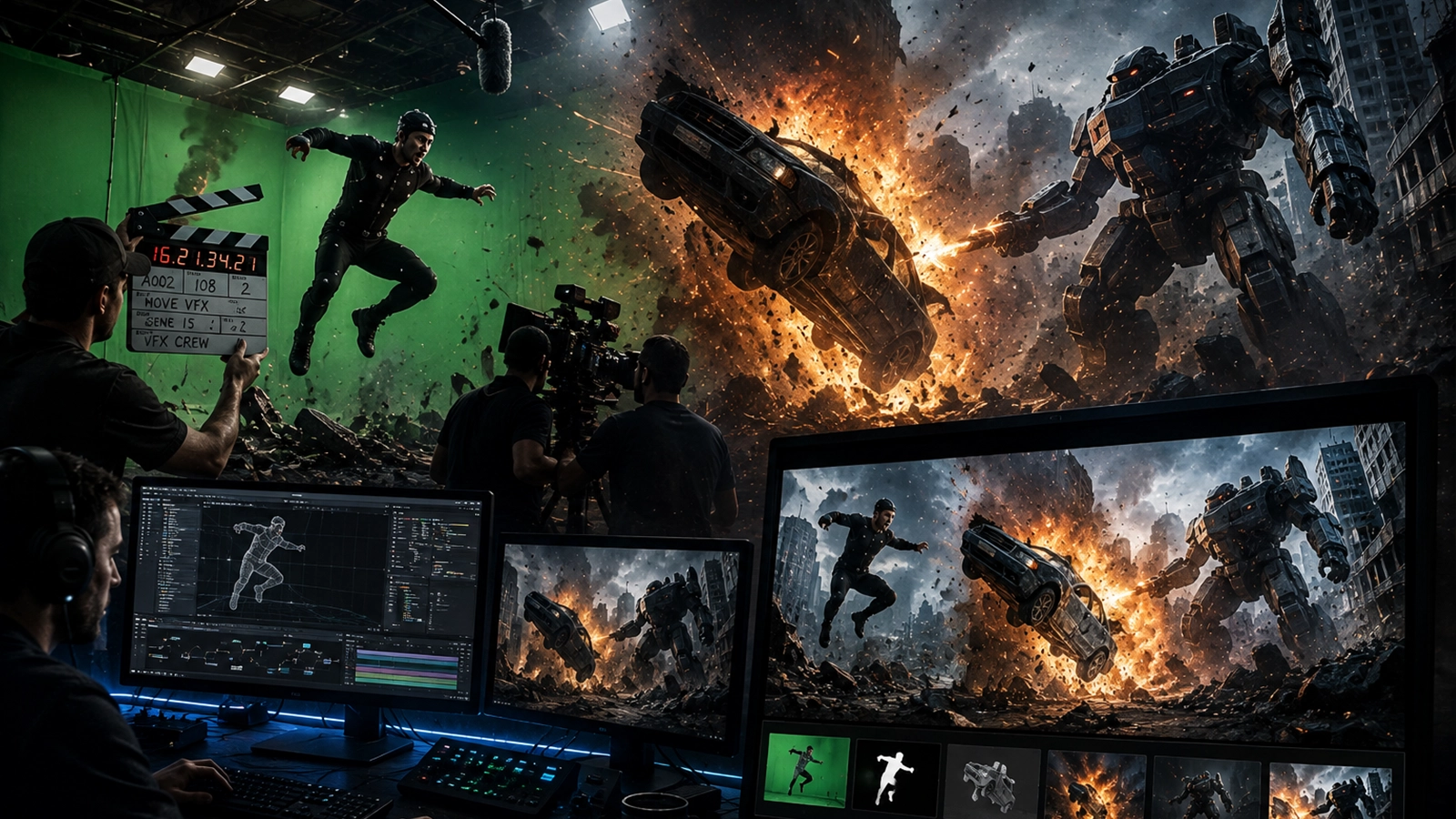
AI tracking converts moving faces, bodies and hands into usable data for VFX, digital humans, animation, face replacement and performance-driven characters.
1. What AI performance tracking means
Performance tracking extracts movement information from footage or sensors. Depending on the system, the output can include facial landmarks, head pose, body joints, hand joints or broader motion signals.
→ DETECTION
→ LANDMARKS / POSE
→ TRACK THROUGH TIME
→ SOLVE
→ CLEAN
→ RETARGET
→ VFX / ANIMATION
The output is data, not finished animation. Artists still need to correct tracking errors, smooth unwanted noise and preserve the intention of the performance.
2. Facial tracking
Facial tracking estimates the movement and deformation of a face. It can support face replacement, digital doubles, facial animation, lip sync and character performance.
| Facial data | Typical use |
|---|---|
| Head rotation | Match a digital head to the plate. |
| Eye direction | Gaze and character performance. |
| Brows | Expression control. |
| Mouth landmarks | Lip sync and dialogue animation. |
| Face deformation | Blendshape or rig-driven animation. |
For digital humans, facial tracking is most useful when it preserves both timing and subtle expression instead of reducing the performance to a few obvious poses.
3. Body and pose tracking
Pose tracking estimates the locations or rotations of major body joints. It can convert live-action reference into animation data or help isolate a performer for VFX.
| Body area | Tracking challenge |
|---|---|
| Torso | Occlusion and clothing can obscure landmarks. |
| Arms | Crossing limbs create ambiguity. |
| Legs | Perspective and partial occlusion affect estimates. |
| Feet | Contact with the floor must remain believable. |
| Full body | Camera perspective and depth are harder to infer from a single view. |
4. Hand tracking
Hands are among the most difficult parts of human tracking because fingers are small, frequently overlap and can move rapidly.
- Track the wrist and palm first.
- Check finger identity during crossings.
- Watch for missing fingers and impossible joint angles.
- Use temporal smoothing carefully.
- Manually correct hero hand poses when needed.
Never judge hand tracking from a still frame alone. Play the complete gesture at normal speed.
5. Performance capture
Performance capture turns an actor’s movement into data that can drive a digital character. AI tracking can make capture more accessible by extracting motion from ordinary video, while dedicated capture systems can provide more controlled data.
| Capture approach | Strength | Trade-off |
|---|---|---|
| Single-camera AI tracking | Accessible and fast. | Depth and occlusion ambiguity. |
| Multi-camera capture | Better spatial information. | More setup and calibration. |
| Marker-based capture | Precise tracking signals. | Requires markers and controlled conditions. |
| Facial capture | Detailed expression. | Requires careful face calibration. |
6. Solving and cleaning tracking data
Raw tracking data often contains jitter, gaps, spikes or incorrect joint assignments. Cleaning is where tracking becomes usable animation.
→ REMOVE SPIKES
→ FILL GAPS
→ SMOOTH NOISE
→ PRESERVE PERFORMANCE
→ CHECK CONTACTS
→ APPROVE SOLVE
Over-smoothing can be just as damaging as noisy data. It may remove the subtle timing that makes a performance feel human.
7. Retargeting to characters
Retargeting maps tracked movement onto a character rig. Different characters have different proportions, so the mapping must respect the target skeleton.
| Issue | Solution |
|---|---|
| Different limb lengths | Use a calibrated retarget system. |
| Foot sliding | Lock or correct ground contacts. |
| Shoulder mismatch | Adjust rig mapping and proportions. |
| Facial mismatch | Map landmarks to blendshapes or facial controls. |
| Extreme pose | Correct manually rather than forcing the solver. |
8. Camera tracking
Character tracking and camera tracking solve different problems but often work together. The camera solve establishes the shot’s spatial frame, while body/face tracking describes the performer.
+
BODY TRACK
+
FACE TRACK
+
HAND TRACK
↓
UNIFIED PERFORMANCE
↓
DIGITAL CHARACTER / VFX
See AI Motion Tracking for camera, object tracking and matchmove.
9. VFX and compositing uses
Tracking data can drive many VFX tasks beyond character animation.
| Use | Tracking data |
|---|---|
| Face replacement | Facial landmarks + head motion. |
| Digital double | Body + face performance. |
| CG helmet / mask | Head pose and camera tracking. |
| Character effects | Body/limb positions. |
| Handheld props | Hand and object relationships. |
| Roto assistance | Body/face motion guidance. |
Combine tracking with AI VFX Cleanup and AI Compositing when integrating the result.
10. Tools and workflow choices
| Category | Typical role |
|---|---|
| AI pose estimation | Body landmarks from video. |
| Face tracking | Expressions, head pose and face replacement. |
| Hand tracking | Finger and gesture data. |
| Motion capture | Higher-control performance capture. |
| 3D animation tools | Retargeting, rigging and cleanup. |
| Compositing tools | VFX integration and final cleanup. |
Tool capabilities change quickly, so the best production choice depends on camera conditions, required accuracy, shot complexity and how much manual correction is acceptable.
11. Common mistakes
| Mistake | Why it fails | Better approach |
|---|---|---|
| Trusting every frame | AI can make isolated tracking errors. | Review the complete motion. |
| Over-smoothing | Performance becomes robotic. | Preserve intentional movement. |
| Ignoring foot contact | Character floats or slides. | Correct ground contacts. |
| Ignoring occlusion | Joints can jump to the wrong location. | Manually correct difficult sections. |
| Wrong camera solve | Character and environment disagree. | Validate camera and performer solves together. |
| No scale calibration | Motion feels wrong on the target character. | Calibrate proportions and units. |
12. Complete Zgian tracking workflow
↓
CAMERA SOLVE
↓
FACE / BODY / HAND DETECTION
↓
TRACK THROUGH TIME
↓
CLEAN DATA
↓
RETARGET
↓
ANIMATION REFINEMENT
↓
CG / DIGITAL HUMAN
↓
COMPOSITE
↓
TEMPORAL QC
↓
FINAL MASTER
- Inspect the source and identify tracking targets.
- Calibrate the camera and character scale.
- Track face, body and hands.
- Review and clean the raw data.
- Retarget to the character rig.
- Correct contacts and hero poses.
- Integrate the character or VFX element.
- Match camera, lighting and motion blur.
- Review the complete shot at full speed.
13. Final tracking QC
- Check face stability.
- Check eye direction.
- Check mouth and lip timing.
- Check shoulders and hips.
- Check hands and fingers.
- Check foot contacts.
- Check camera lock.
- Check retargeting proportions.
- Check motion blur and temporal stability.
- Review the final composite, not only the tracking viewport.
How this fits the Zgian VFX + AI pipeline
AI DIGITAL HUMANS → Digital Humans
AI ROTO → AI Rotoscoping
AI CLEANUP → AI VFX Cleanup
AI COMP → AI Compositing
VIRTUAL PRODUCTION → AI Virtual Production
Frequently asked questions
What is AI face tracking?
AI face tracking estimates facial landmarks, head motion and sometimes facial deformation through a sequence so the data can drive VFX or character animation.
What is pose tracking?
Pose tracking estimates the positions or rotations of body joints, allowing movement from footage to be analyzed or retargeted to a digital character.
Can AI track hands?
Yes. AI systems can estimate hand and finger landmarks, although occlusion and fast finger movement can make hand tracking difficult.
Is AI tracking the same as motion capture?
Not exactly. AI tracking can extract motion from ordinary video, while motion capture is a broader category that includes dedicated sensor, camera and marker-based systems.
How do I make AI tracking look natural?
Clean the tracking data without removing useful performance, correct contacts and difficult poses, then review the complete animation in context.
Continue the Zgian VFX + AI series
3D Generalist & VFX Professional · About the author →