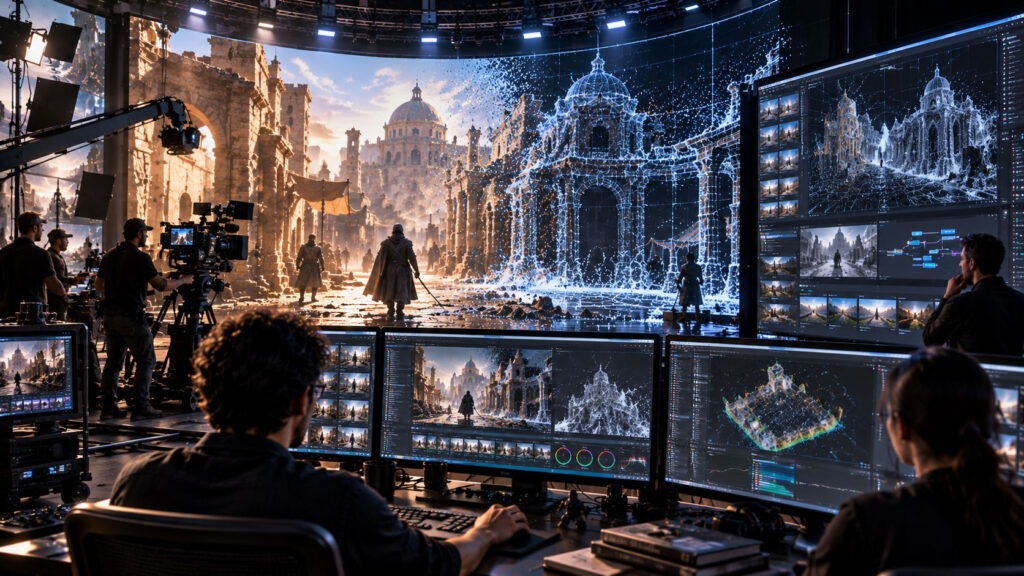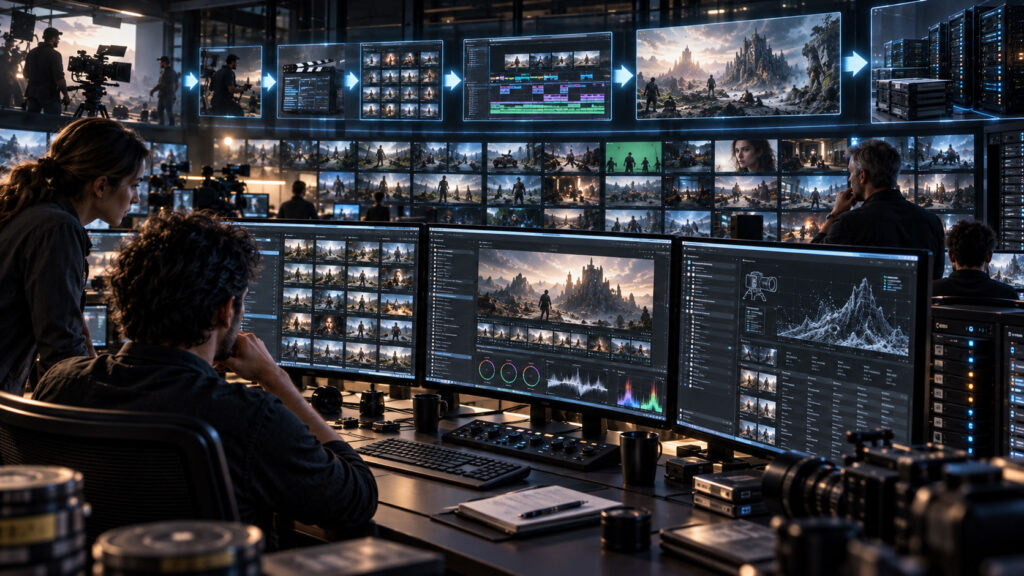
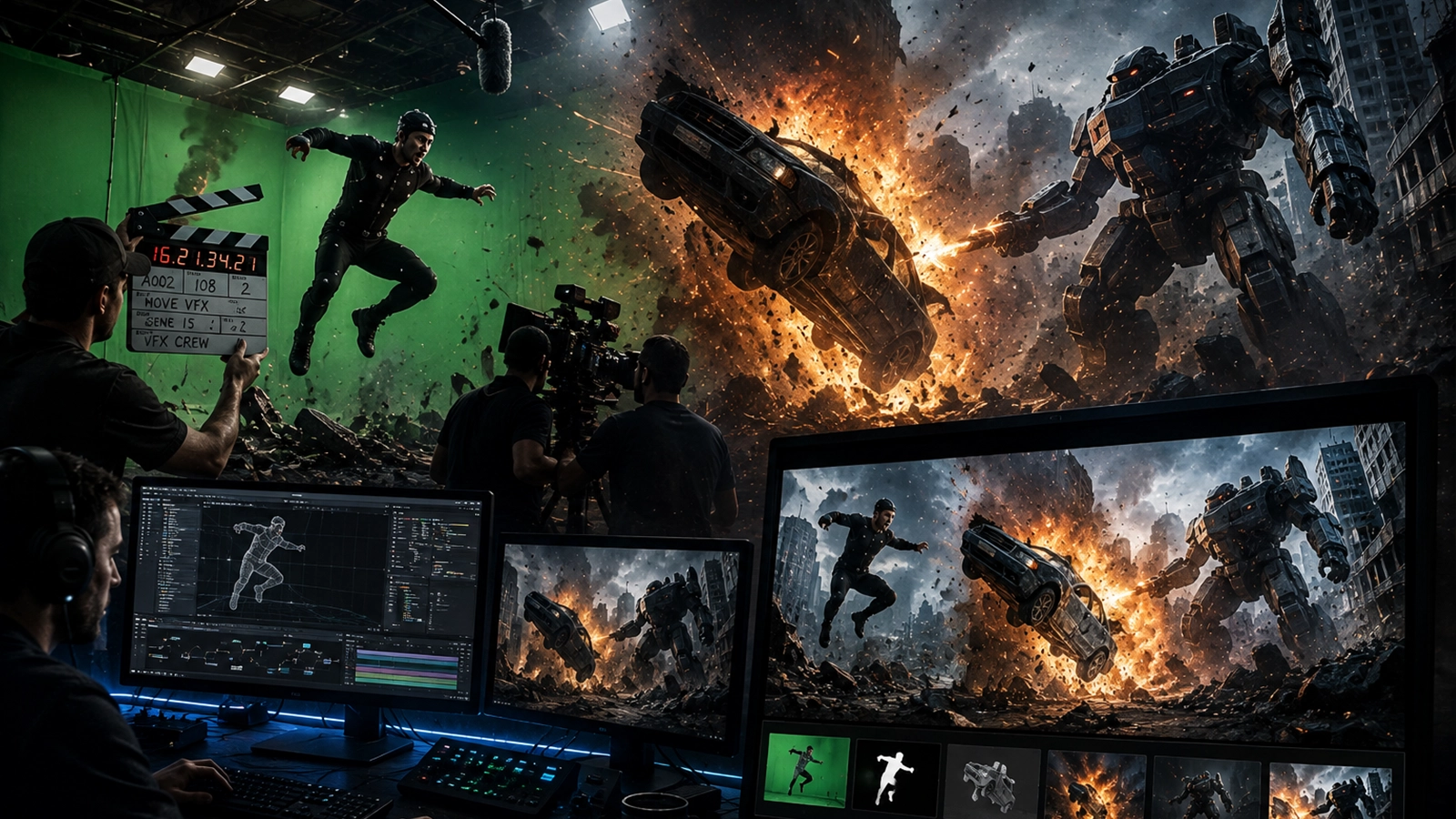
A professional matchmove is more than a collection of tracking points. It is a camera and scene solution that lets CG, set extensions and VFX elements live convincingly inside live-action footage.
1. What matchmoving actually solves
Matchmoving recreates the camera and relevant scene motion from live-action footage so digital elements can be placed in the same coordinate system.
→ FEATURE TRACKS
→ CAMERA SOLVE
→ LENS / DISTORTION
→ SCENE SCALE
→ OBJECT TRACKS
→ CG / VFX INTEGRATION
A good solve reproduces the image motion closely enough that the virtual camera behaves like the real camera.
2. Plate and camera analysis
Before tracking, inspect the footage. Frame rate, resolution, rolling shutter, lens distortion, stabilization and camera movement can all affect the solve.
| Plate characteristic | Why it matters |
|---|---|
| Known focal length | Provides a useful lens starting point. |
| Unknown lens | The solver may need to estimate camera parameters. |
| Stabilized footage | Artificial motion can complicate physical camera solving. |
| Rolling shutter | Different image rows can represent different moments. |
| Heavy distortion | Track geometry can drift if distortion is ignored. |
3. Building reliable tracks
Good tracks are stable, visible and distributed across the image and depth of the scene. AI can accelerate feature detection, but artists should reject points on reflections, moving objects and unstable textures.
| Track | Good candidate | Risky candidate |
|---|---|---|
| High contrast point | Corner on a static object. | Specular highlight. |
| Texture feature | Stable wall or building detail. | Animated screen. |
| Ground feature | Fixed road or floor detail. | Moving shadow. |
| Natural feature | Static environmental structure. | Leaves moving in wind. |
4. 3D camera solving
The solver uses tracked image movement to estimate camera position, rotation and often lens parameters. A visually dense track set does not guarantee a correct solve; the points must be consistent with a plausible camera and scene.
+
CAMERA MODEL
+
LENS PARAMETERS
↓
3D CAMERA SOLVE
↓
REPROJECTION TEST
Check the solve by placing test geometry into the scene and observing whether it stays locked to the plate.
5. Lens and distortion
Lens behavior can be critical for matchmove. Wide lenses may introduce visible distortion, while changing zoom or focus can alter the camera model.
| Lens issue | Possible response |
|---|---|
| Barrel distortion | Undistort before precise tracking when appropriate. |
| Pincushion distortion | Use a lens model or distortion solve. |
| Zoom shot | Account for changing focal length. |
| Unknown lens | Estimate and validate against geometry. |
Do not use a distortion correction simply because it is available. The correction should improve the consistency of the solve.
6. Object tracking
Sometimes the camera is not the only moving element that needs to be reconstructed. Object tracking can describe a vehicle, prop, sign, robot or other rigid element moving through the scene.
| Object | Useful data |
|---|---|
| Vehicle | Position, rotation and wheel relationships. |
| Prop | Translation and orientation. |
| CG replacement | Object motion plus camera solve. |
| Set piece | Rigid movement relative to environment. |
7. Planar tracking
Planar tracking estimates the movement and perspective of a relatively flat surface. It is useful for screens, signs, posters, walls and many cleanup tasks.
→ TRACK CORNERS / TEXTURE
→ SOLVE PERSPECTIVE
→ ATTACH PATCH / GRAPHIC / CLEANUP
→ REVIEW
Planar tracking and 3D camera tracking are complementary. Choose the simplest tracking model that accurately represents the task.
8. Scene scale and coordinate systems
A camera can appear to solve correctly while the scene scale is wrong. Establish a sensible coordinate system and known measurements when they are available.
| Reference | Use |
|---|---|
| Known object size | Set scene scale. |
| Ground plane | Establish world orientation. |
| Vertical architecture | Check horizon and camera height. |
| Survey data | Improve accuracy when available. |
9. CG and VFX integration
Once the camera and object solves are approved, the scene can support CG elements, set extensions, digital doubles, effects and compositing.
| Integration | Matchmove requirement |
|---|---|
| CG prop | Camera plus object placement. |
| Set extension | Camera, lens and ground relationship. |
| Digital human | Camera plus performance tracking. |
| Particle effect | Camera and world-space orientation. |
| Screen replacement | Planar or 3D surface tracking. |
Combine with AI Face & Body Tracking, AI Green Screen and AI Cleanup 2.0 as needed.
10. Where AI helps
AI can speed up repetitive parts of matchmove without replacing the need for scene judgment.
| AI-assisted task | Benefit |
|---|---|
| Feature detection | Find useful image points quickly. |
| Track filtering | Identify unstable or suspicious tracks. |
| Object segmentation | Separate moving objects from camera tracks. |
| Track propagation | Extend useful tracks through frames. |
| Scene analysis | Assist with geometry and motion interpretation. |
The artist remains responsible for choosing tracks, validating the camera model and ensuring the result works in the final shot.
11. Common mistakes
| Mistake | Why it fails | Better approach |
|---|---|---|
| Tracking every visible point | Moving or reflective features contaminate the solve. | Select stable environmental features. |
| Ignoring lens distortion | Geometry can drift across the frame. | Analyze lens behavior and validate the model. |
| Trusting solve statistics alone | Low error does not guarantee physical correctness. | Use test geometry and visual validation. |
| Wrong scene scale | CG integration feels inconsistent. | Use known measurements when available. |
| Ignoring rolling shutter | Fast motion can produce inconsistent geometry. | Account for camera behavior in difficult shots. |
| Never checking the final composite | Small drift becomes obvious downstream. | Test actual CG/VFX elements early. |
12. Complete Zgian Camera Tracking 2.0 workflow
↓
DISTORTION ANALYSIS
↓
FEATURE TRACKING
↓
TRACK CLEANUP
↓
3D CAMERA SOLVE
↓
LENS VALIDATION
↓
OBJECT / PLANAR TRACKS
↓
SCENE SCALE + GROUND
↓
TEST GEOMETRY
↓
CG / VFX INTEGRATION
↓
FINAL MATCHMOVE QC
- Inspect the source and camera characteristics.
- Identify stable features across the shot.
- Track and remove unreliable points.
- Solve the 3D camera.
- Validate lens and distortion assumptions.
- Establish scene scale and coordinate orientation.
- Add object or planar tracks where required.
- Test with simple CG geometry.
- Approve only after checking the final VFX integration.
13. Final matchmove QC
- Check camera lock.
- Check track stability.
- Check lens and distortion.
- Check horizon and ground plane.
- Check scene scale.
- Check object tracks.
- Check CG contact and parallax.
- Check edge drift through the entire shot.
- Check fast camera movement.
- Review the final composite at normal speed and frame-by-frame.
How this fits the Zgian VFX + AI pipeline
AI PERFORMANCE TRACKING → Face & Body Tracking
AI ROTO → AI Rotoscoping 2.0
AI CLEANUP → AI Cleanup 2.0
AI KEYING → AI Green Screen
AI COMP → AI Compositing
Frequently asked questions
What is matchmoving?
Matchmoving is the process of reconstructing camera and/or object motion from live-action footage so digital elements can be integrated into the shot.
What is a 3D camera solve?
It is an estimated camera position, rotation and lens model that reproduces the observed movement of tracked image features.
Can AI do camera tracking automatically?
AI can accelerate feature detection, tracking and parts of solving, but production shots still need validation and artist control.
What is planar tracking used for?
Planar tracking is useful for relatively flat surfaces such as screens, signs, posters and walls where perspective changes can be estimated reliably.
How do I know if a camera solve is good?
Do not rely only on numerical error. Place test geometry into the scene and verify that it remains locked to real features throughout the shot.
Continue the Zgian VFX + AI series
3D Generalist & VFX Professional · About the author →