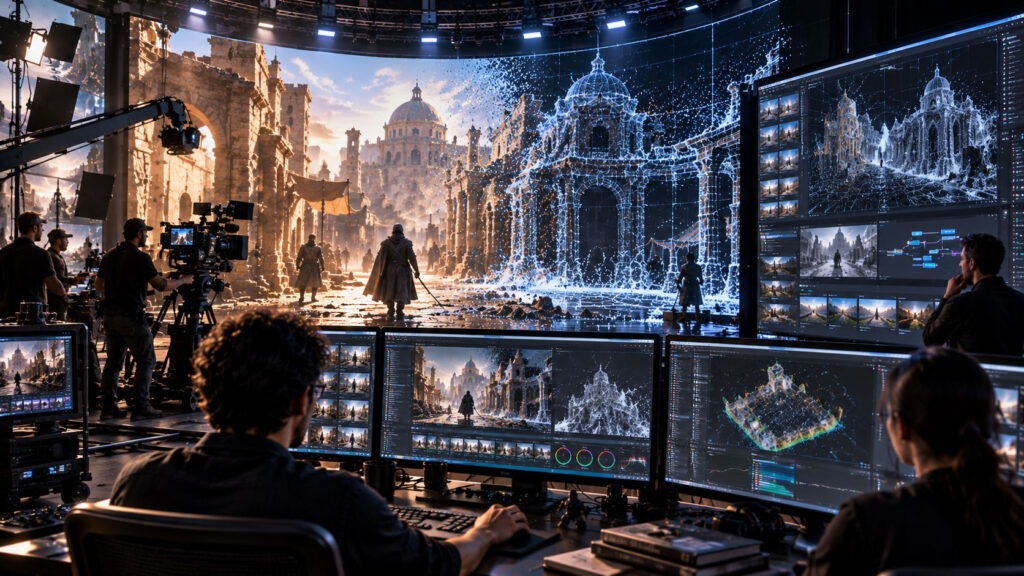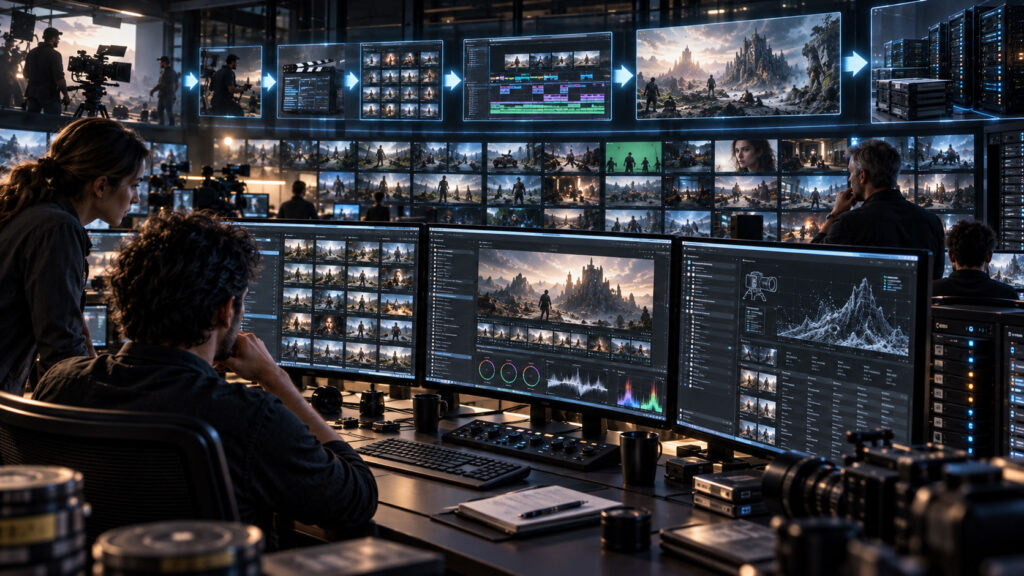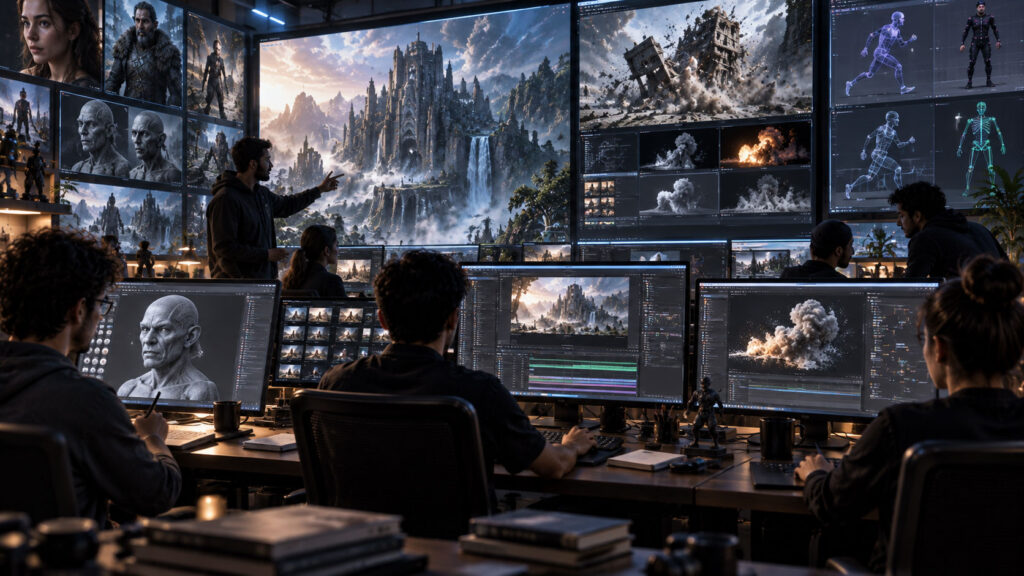
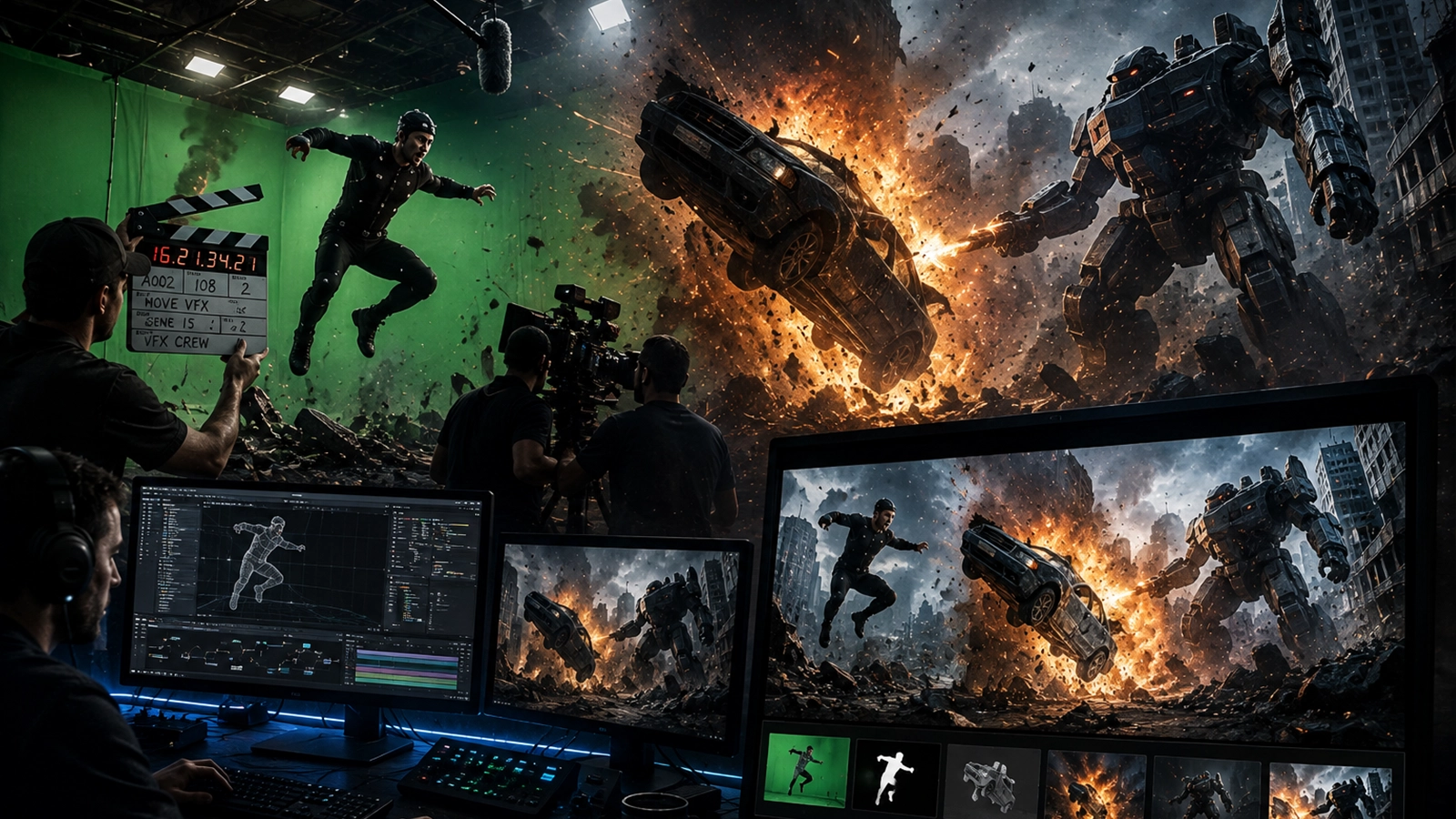
Tracking is the invisible foundation of VFX. AI can speed the analysis, but a production-ready track still has to lock perfectly to the plate.
1. What motion tracking actually does
Motion tracking measures how something changes position, scale, rotation or perspective over time. That information lets you attach a new element to the original footage.
→ FIND FEATURES
→ TRACK MOVEMENT
→ SOLVE MOTION
→ ATTACH VFX ELEMENT
→ CHECK LOCK
Without a reliable track, even a beautifully rendered CG asset can appear to slide, float or vibrate.
2. 2D, planar, object and 3D tracking
| Tracking type | Best for | Typical output |
|---|---|---|
| 2D point tracking | Simple graphics, screen points, stabilization. | Position, scale, rotation. |
| Planar tracking | Signs, screens, walls and flat surfaces. | Surface transform / corner data. |
| Object tracking | Moving props or characters. | Object motion. |
| 3D camera tracking | CG and set extensions. | Virtual camera + scene solve. |
| Matchmove | Production VFX integration. | Camera/object solution usable in 3D. |
3. Analyze the shot before tracking
AI does not remove the need for shot analysis. Before pressing “track,” identify what the VFX element needs to follow.
- Is the camera moving?
- Is the object moving independently?
- Is the surface flat?
- Does the shot contain motion blur?
- Are there enough stable features?
- Are objects crossing the tracking area?
- Is there lens distortion?
- Does the shot need a 3D camera solve?
Choose the tracking method from the VFX requirement, not from the AI feature list.
4. AI-assisted 2D tracking
AI can help identify visual features and maintain tracks when ordinary feature tracking becomes difficult. It is especially useful for repetitive or large batches of shots.
| Good candidate | Why |
|---|---|
| Graphic replacement | Only needs a stable transform. |
| Logo replacement | Track can drive a 2D layer. |
| Simple face/eye attachment | Object-aware tracking can reduce setup time. |
| Stabilization | Track data can drive inverse motion. |
Always inspect the track overlay on the original footage. A track that looks plausible in a graph can still drift visibly when used in the shot.
5. Planar tracking
Planar tracking analyzes the movement of a surface rather than a single point. It is excellent for screens, posters, signs, floors and other relatively flat regions.
Planar tracking checklist
- Select a surface with enough texture.
- Exclude moving foreground objects where possible.
- Track from a clean frame.
- Check perspective changes.
- Apply the track to a test graphic.
- Review the replacement at full speed.
AI assistance can make object/surface identification faster, but the same principle applies: the final replacement must remain locked to the real surface.
6. Object tracking
Object tracking follows a moving item through the scene. This is useful for replacing props, adding graphics, attaching effects or building a CG object interaction.
| Object | Useful tracking cues |
|---|---|
| Car | Body edges, wheels, windows and high-contrast details. |
| Face | Stable facial features plus head movement. |
| Phone | Screen corners and planar surface. |
| Weapon/prop | Distinct shape and high-contrast features. |
| Creature | Body landmarks plus object/3D tracking when necessary. |
7. 3D camera tracking
3D camera tracking attempts to reconstruct the camera movement and a representation of the scene from 2D footage. The resulting virtual camera lets you place CG objects into the shot.
→ CAMERA MOTION ANALYSIS
→ 3D CAMERA SOLVE
→ POINT CLOUD / TRACK POINTS
→ GROUND PLANE / SCALE
→ CG INSERTION
AI can assist feature detection and analysis, but a successful camera solve is more than a numerical result. The CG must behave correctly when viewed through the solved camera.
Validate the solve
- Place a simple 3D object in the scene.
- Scrub through the shot.
- Check sliding against the floor/walls.
- Check perspective and scale.
- Check whether the camera feels locked.
8. Matchmove for CG
Matchmove combines camera and/or object tracking so CG can interact convincingly with live-action or AI-generated plates.
| Requirement | Matchmove data |
|---|---|
| CG object in environment | Camera solve + scene scale. |
| Object replacement | Object transform / animation solve. |
| Set extension | Camera solve + projection/layout. |
| Creature interaction | Camera + performer/object tracking. |
| Digital double | Camera + body/object tracking and animation data. |
For AI-generated footage, matchmove can be especially useful because generated cameras often do not provide production metadata. Tracking reconstructs the motion needed by downstream VFX.
9. Why AI and traditional tracks fail
| Failure | Cause | Fix |
|---|---|---|
| Drift | Weak or changing feature. | Use better features or manual corrections. |
| Jump | Occlusion or feature swap. | Split the track and solve separately. |
| Sliding CG | Incorrect camera/object solve. | Recheck solve, scale and ground plane. |
| Perspective mismatch | Wrong tracking method. | Use planar/3D tracking where required. |
| Motion-blur loss | Feature becomes ambiguous. | Use additional keyframes/features. |
| AI identity switch | Model follows a similar object. | Correct the target and inspect occlusions. |
10. AI tracking tools in 2026
The tool landscape changes quickly, so choose based on the task rather than a generic “best AI tracker” list.
| Tool / approach | Useful for | Workflow role |
|---|---|---|
| Adobe After Effects tracking + AI features | 2D/object-aware VFX work. | Fast editorial-to-VFX workflow. |
| DaVinci Resolve / Fusion | Tracking, masks, compositing and finishing. | Integrated post workflow. |
| Nuke | Professional node-based tracking/compositing. | High-end VFX production. |
| Blender / 3D matchmove workflows | Camera solve and CG integration. | Accessible 3D pipeline. |
| AI vision/segmentation systems | Feature and object analysis. | Automation layer around tracking. |
Current Adobe documentation describes AI-powered object isolation in After Effects, while professional applications such as Nuke and Fusion continue to combine tracking with deeper compositing and VFX controls.
11. Complete Zgian AI tracking workflow
↓
SHOT ANALYSIS
↓
CHOOSE TRACK TYPE
↓
AI / AUTOMATIC TRACK
↓
CLEAN TRACK
↓
SOLVE
↓
VALIDATE
↓
APPLY TO GRAPHIC / CG / VFX
↓
COMPOSITE
↓
FINAL QC
- Lock the editorial shot.
- Check the source for blur, distortion and artifacts.
- Choose 2D, planar, object or 3D tracking.
- Run the AI/automatic analysis.
- Remove bad features and repair weak sections.
- Solve the camera/object motion.
- Test with a simple insert.
- Integrate the actual VFX element.
- Check at full speed and frame by frame.
12. Common AI tracking mistakes
| Mistake | Why it fails | Better approach |
|---|---|---|
| Tracking without analysis | Wrong method creates unstable data. | Define the VFX requirement first. |
| Using one feature | Occlusion or movement causes drift. | Use multiple reliable features. |
| Trusting the solve score alone | Numerical accuracy does not guarantee visual lock. | Test with a real insert. |
| Ignoring lens distortion | CG can slide at the edges. | Model/correct distortion where needed. |
| Not checking full speed | Small drift becomes obvious in motion. | Review the complete shot. |
13. Final tracking QC
- Overlay the track on the original plate.
- Check the first and last frames.
- Check all major occlusions.
- Check fast movement.
- Test with a simple graphic or 3D locator.
- Check ground-plane stability.
- Check lens distortion.
- Check the final VFX element at full speed.
- Render a test before committing to the full shot.
How this fits the Zgian VFX + AI pipeline
AI VFX → AI VFX Workflow
AI ROTO → AI Rotoscoping
AI COMP → AI Compositing
AI TRACKING → this guide
COLOR → AI Film Color Grading
Frequently asked questions
What is AI motion tracking?
AI motion tracking uses computer vision and learned models to identify and follow image features, objects or camera movement through a sequence.
Can AI do 3D camera tracking?
AI can assist parts of camera analysis and feature detection, but production 3D matchmove still needs a validated camera solve and scene setup.
What is matchmove?
Matchmove is the process of reconstructing camera and/or object movement from footage so CG and other VFX elements can be integrated accurately.
Why does my CG object slide?
Common causes include an incorrect camera/object solve, poor tracking features, wrong scene scale, lens distortion or an incorrect ground plane.
Should I trust automatic tracking?
Use it as a first pass. Always validate the result with an actual graphic or CG element and review the entire shot.
Continue the Zgian VFX + AI series
3D Generalist & VFX Professional · About the author →