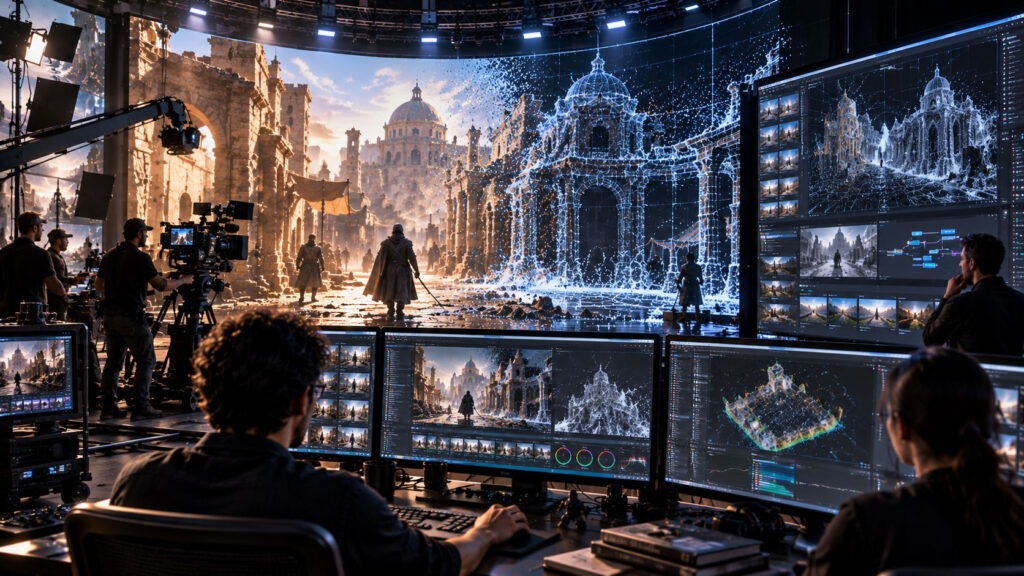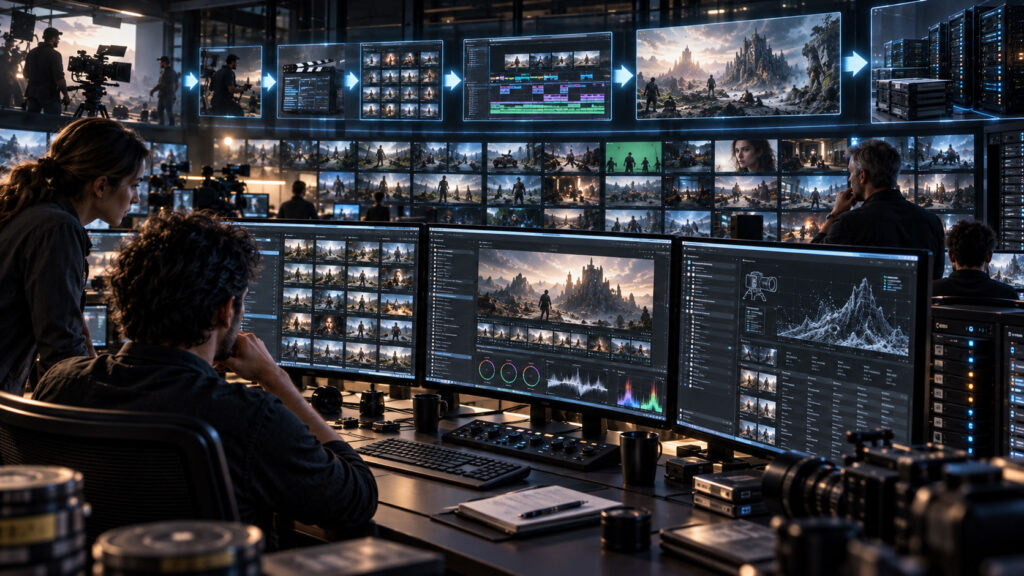
How modern AI-assisted cleanup removes unwanted people, wires, rigs, signs and props—plus when traditional paint and compositing are still the better choice.
What is AI object removal?
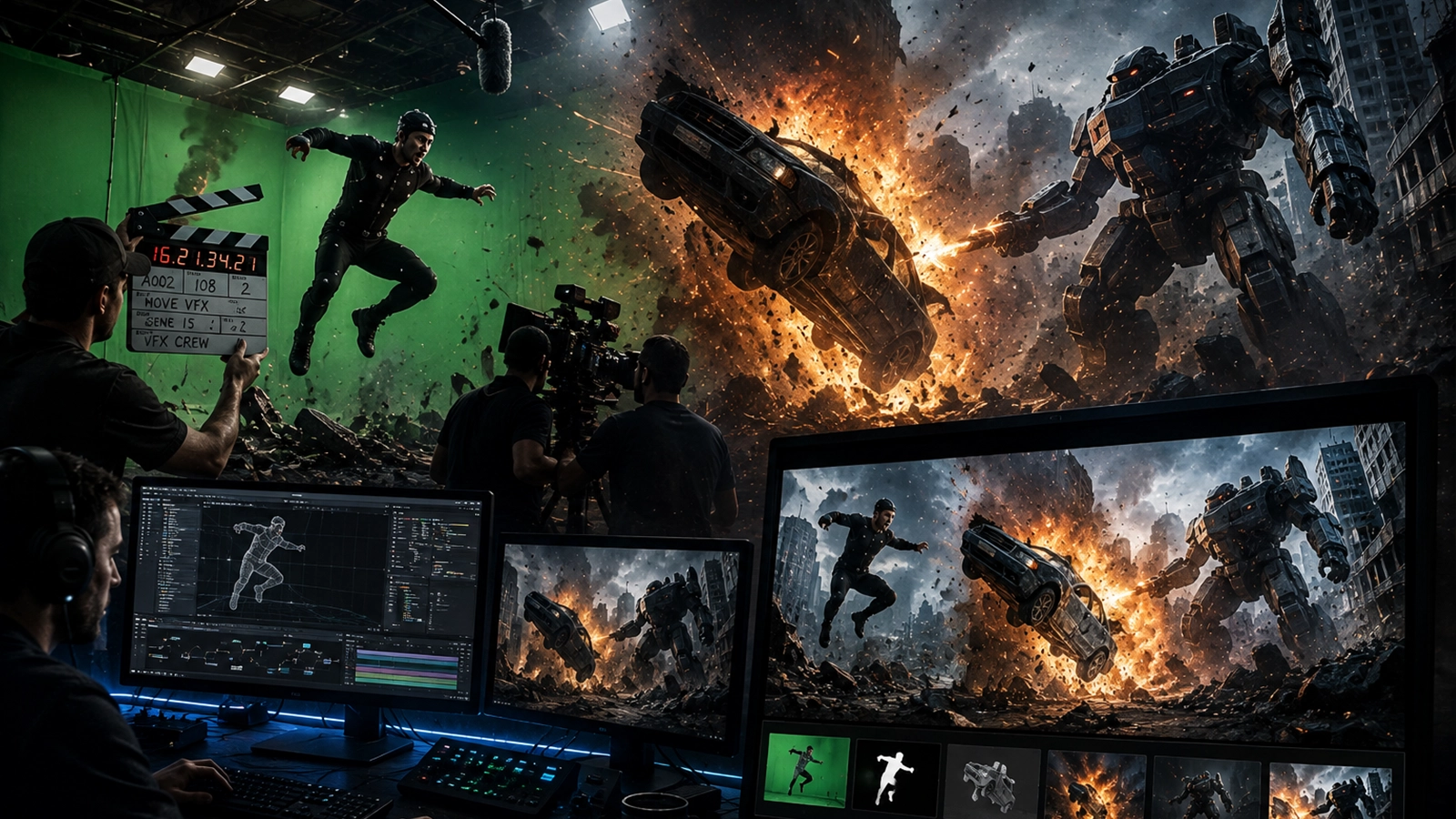
Object removal is a VFX cleanup technique used to make an unwanted element disappear from footage. Common examples include boom microphones, tracking markers, wires, crew members, signs, vehicles, logos and unwanted props.
AI-assisted systems can analyze surrounding image information and reconstruct the missing area. The important difference from simply deleting pixels is that the replacement must remain believable across time.
When AI object removal works best
| Shot type | Why it can work | Watch for |
|---|---|---|
| Static background | Many clean pixels are available. | Repeating textures. |
| Simple camera move | Tracking can follow the removal area. | Perspective changes. |
| Small object | Less background must be reconstructed. | Edge contamination. |
| Large moving person | AI can accelerate the first pass. | Shadows, reflections and occlusion. |
| Complex reflections | Research systems are improving. | Temporal artifacts and incorrect reflections. |
Step-by-step AI object removal workflow
- Analyze the shot. Find the unwanted object and identify what background it covers.
- Create a mask. Isolate the object and include important shadows or traces when appropriate.
- Track the mask. Follow position, scale and rotation as the camera or object moves.
- Generate the fill. Use AI reconstruction or Content-Aware Fill to replace the masked region.
- Inspect the result. Look for texture repetition, warping and temporal flicker.
- Repair problem frames. Use reference frames, paint, clone or additional masks.
- QC the whole shot. Never approve a removal from one still frame.
Adobe’s current tutorial demonstrates this exact general pattern: mask the unwanted object, track the mask through camera movement, select Object as the Content-Aware Fill method and generate the fill layer.
Removing people from video
Removing a person is often harder than removing a small prop because the person can cover a large area and cast a moving shadow. A useful workflow is to create a strong subject mask, track it, generate the background reconstruction and then inspect the entire sequence.
Adobe currently documents Content-Aware Fill as a method for removing unwanted people and objects from live-action footage.
Key checks
- Does the person’s shadow remain?
- Does the background texture move naturally?
- Are feet or contact points leaving artifacts?
- Are reflections still visible?
- Does the fill change suddenly between frames?
Removing wires, cables and rigs
Wire removal is a classic VFX cleanup problem. The wire may be thin, move independently and cross detailed textures. AI can speed up the first pass, but a tracked paint or clone workflow may provide more control for difficult shots.
Fusion’s current documentation specifically demonstrates painting and cloning out an unwanted boom mic, with paint strokes that can follow tracked objects.
Removing props, signs and unwanted objects
For a sign or prop, first ask whether the object is actually obscuring a background that exists elsewhere in the shot. If clean reference pixels exist, traditional patching may be more reliable than a generative fill.
| Object | Useful first approach |
|---|---|
| Small logo | Tracked mask + patch/fill. |
| Tracking marker | Paint/clone or Content-Aware Fill. |
| Boom mic | Tracked removal + clean plate. |
| Background person | AI segmentation + fill + shadow cleanup. |
| Large vehicle | AI fill only if clean reference information is sufficient; otherwise build a controlled patch. |
Shadows, reflections and other visual traces
Removing the object is only half the problem. Its visual effects can remain after the object disappears.
Adobe Research’s Object-WIPER project, accepted at CVPR 2026, specifically investigates removing unwanted objects together with associated effects such as shadows, reflections and translucent traces. It is research, not an Adobe product feature, but it shows where the field is moving.
Object removal ≠ effect removal. A believable cleanup may require separate treatment for the object, shadow, reflection and environmental interaction.
Difficult shots and how to handle them
| Problem | Why it fails | Better response |
|---|---|---|
| Fast camera movement | Fill area changes rapidly. | Improve tracking and split the shot. |
| Large object | Too little clean background reference. | Use clean plates or manual reconstruction. |
| Water | Texture changes continuously. | Use dedicated reference and temporal cleanup. |
| Glass/reflections | Object affects multiple layers. | Separate reflection cleanup. |
| Fine hair/fog | Soft boundaries are ambiguous. | Combine roto, masks and manual paint. |
AI vs traditional object removal
| Method | Strength | Best use |
|---|---|---|
| AI / Content-Aware Fill | Fast reconstruction | Simple or moderate backgrounds |
| Generative video research | Can infer complex replacement content | Experimental/problem-solving workflows |
| Clone / paint | Precise control | Wires, markers and small fixes |
| Clean plate | Predictable source pixels | Repeated shots and controlled production |
| 3D reconstruction | Strong perspective control | Large objects and complex camera moves |
After Effects currently combines Content-Aware Fill with masks and tracking, while Fusion provides node-based paint, tracking and compositing tools.
Professional object-removal QC checklist
- Watch the shot at normal speed.
- Check the first, middle and last frames.
- Look for texture crawling.
- Look for repeated pixels.
- Check edges around the removed area.
- Check shadows.
- Check reflections.
- Check motion blur.
- Check grain and sharpness.
- Compare before/after frames at 100%.
Example: removing a boom microphone
Imagine a boom mic enters the top of a moving shot. The practical workflow is to mask the microphone, track the mask, generate a fill, inspect the fill for moving texture and then use paint or a reference frame if the reconstruction fails.
The same concept can be used for wires, markers and small unwanted objects. Adobe’s current object-removal tutorials explicitly demonstrate this mask → track → fill approach.
How this fits the Zgian VFX cluster
AI COMP → AI Compositing Guide
AI TRACKING → Camera Tracking Guide
FULL PIPELINE → AI VFX Workflow for Film
Frequently asked questions
Can AI remove people from video?
Yes. AI-assisted workflows can isolate unwanted people and reconstruct the background, but shadows, reflections and temporal consistency still need review.
Can AI remove wires from video?
AI can assist with masking and cleanup, but thin wires often benefit from tracked paint or clone work because precise control is important.
What is Content-Aware Fill?
It is an After Effects tool that reconstructs pixels in masked areas of video. Adobe’s current workflow uses it to remove unwanted objects from footage.
Is AI object removal perfect?
No. Results depend heavily on the amount of clean reference information, camera movement, object size and scene complexity. Always inspect the complete shot.
What is the best workflow for professional VFX cleanup?
Use AI for speed, then combine it with tracking, clean plates, paint, roto and compositing tools whenever the shot requires more control.
Continue the Zgian VFX series
3D Generalist & VFX Professional · About the author →