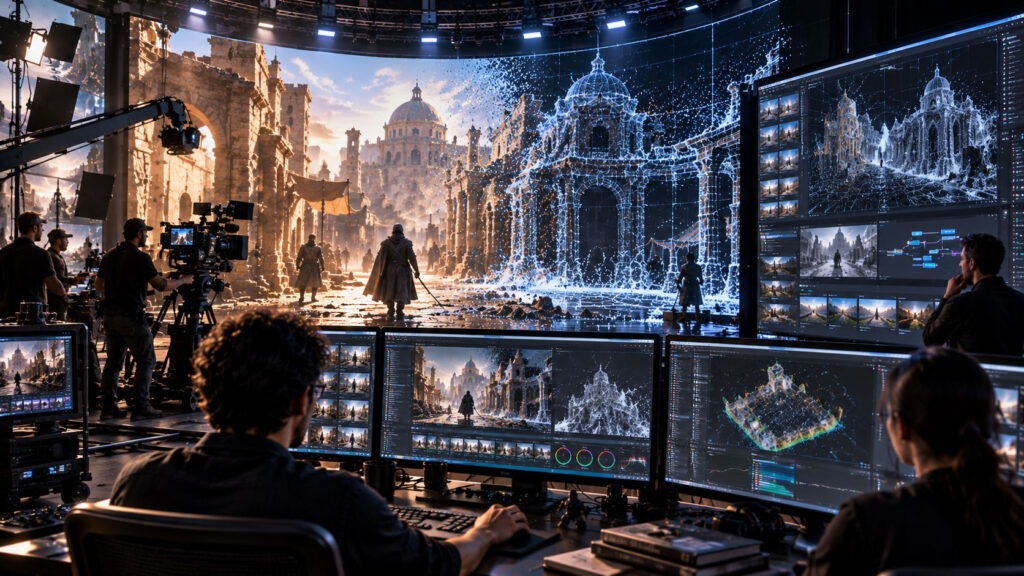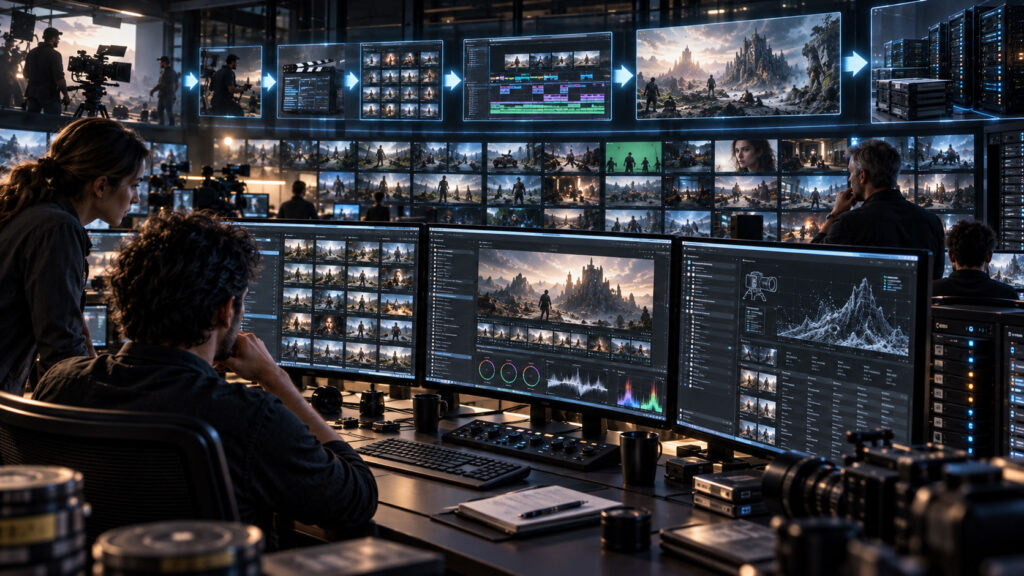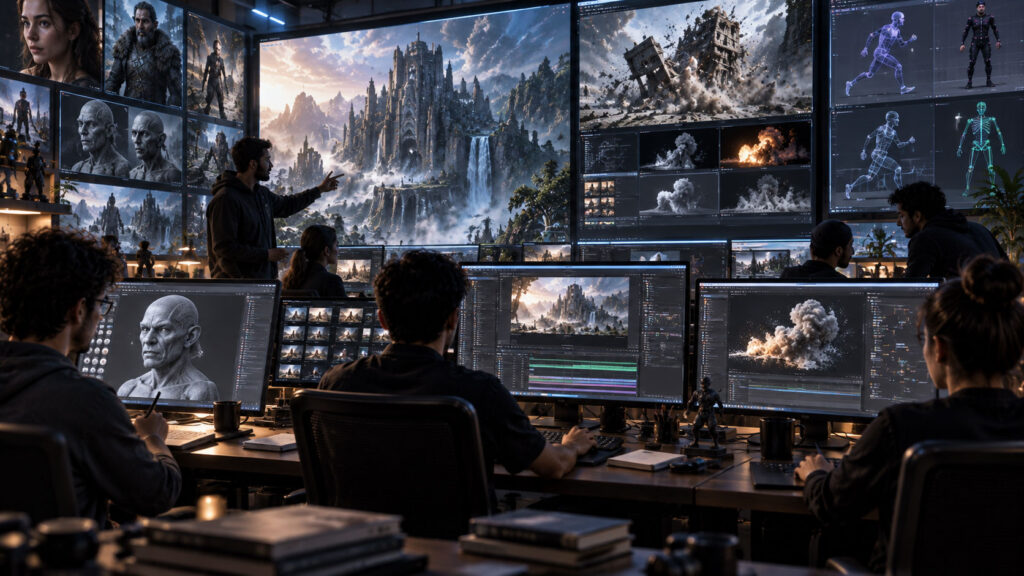
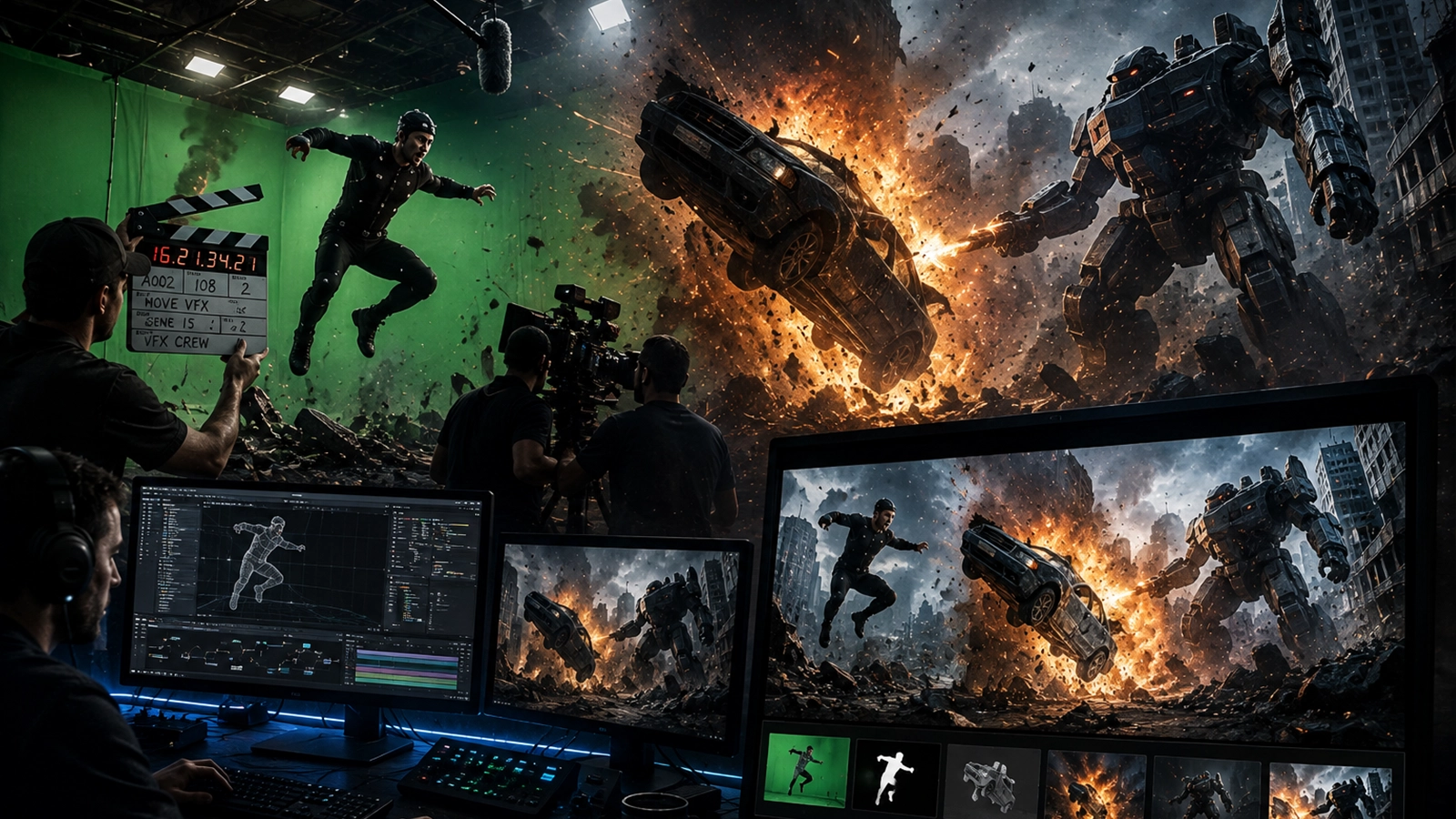
Simulation is where visual effects meet physics, art direction and time. AI can accelerate exploration, prediction and enhancement, but the final effect must still behave at the correct scale, interact with the scene and remain stable throughout the shot.
1. What AI-assisted simulation changes
AI can help artists explore, predict, guide or accelerate simulation workflows, but believable FX still depend on physical behavior, art direction, timing and controlled iteration.
2. AI simulation workflows
AI can assist with simulation parameter exploration, motion prediction, upscaling, denoising and procedural variation. Keep the underlying simulation logic understandable and reproducible.
3. Destruction
Destruction combines rigid-body behavior, fracture patterns, debris, dust and secondary motion. AI can help explore fracture or debris variations while physical constraints preserve believable impact.
4. Fire
Fire depends on fuel, temperature, velocity, turbulence and emission. AI can assist with look exploration or acceleration, but scale and energy must remain consistent with the shot.
5. Smoke
Smoke needs coherent volume motion, density, dissipation and interaction with objects. Temporal stability is critical when AI is used for enhancement or generation.
6. Water
Water simulation covers splashes, waves, spray, foam and interaction with surfaces. AI can help generate or enhance elements, but gravity, scale and contact behavior remain essential.
7. Clouds
Clouds are large-scale volumetric systems shaped by atmosphere, wind and lighting. Procedural and AI-assisted generation should preserve scale and continuity across shots.
8. Particles
Particles can represent dust, sparks, rain, snow, embers and debris. AI-assisted variation can reduce repetition while procedural rules control distribution and motion.
9. Physics
Physics gives FX a believable relationship with gravity, collisions, mass and forces. AI should support artistic control rather than hide physical inconsistencies.
10. Cloth
Cloth simulation requires material properties, collision bodies, constraints and believable secondary motion. AI can assist with prediction or cleanup, while the simulation defines physical response.
11. Hair FX
Hair and fur respond to motion, wind, collisions and grooming. Simulation must remain consistent with the character and shot scale.
12. Procedural FX
Procedural systems make effects repeatable and art-directable. Build reusable emitters, forces, caches and controls instead of creating isolated one-off simulations.
13. AI-assisted simulation
AI can help predict motion, generate variations, interpolate or denoise simulation results. Compare generated output against the intended physical and visual behavior.
14. Real-time FX
Real-time simulations prioritize responsiveness and predictable performance. Use simplified models, scalable effects and level-of-detail controls where necessary.
15. Common mistakes
Avoid incorrect scale, excessive turbulence, uncontrolled particle counts, unstable AI-generated motion, missing collisions and simulations that look impressive but do not support the story.
16. Complete Zgian AI simulation workflow
Define the effect, establish physical and artistic constraints, build the base simulation, use AI for controlled acceleration or variation, cache the result, integrate secondary elements and complete final-pixel QC.
17. Final simulation QC
Review timing, scale, collisions, energy, volume behavior, particles, interaction, temporal stability, cache integrity, render performance and final integration.
How this fits the Zgian AI VFX series
AI VFX 2.0 → Video Transformation
AI VFX 3.0 → Digital Humans
AI VFX 4.0 → Environment Generation
AI VFX 5.0 → this guide
Frequently asked questions
Can AI replace physical simulation?
AI can accelerate or approximate parts of a simulation workflow, but physical constraints and artistic control remain important for production reliability.
What makes destruction believable?
Correct scale, fracture behavior, mass, collisions, debris, dust and secondary motion all contribute to a convincing destruction shot.
Why is scale important in fire and smoke?
Scale controls the apparent speed, turbulence, density and energy of volumetric effects. A mismatch can make an effect look miniature or exaggerated.
Can AI generate water simulations?
AI can assist with generation or enhancement, but water interaction still needs coherent motion, gravity, collisions, foam and spray behavior.
What is the biggest simulation mistake?
Focusing on detail before solving timing, scale and interaction. A technically complex simulation can still look wrong if its fundamental motion is incorrect.