
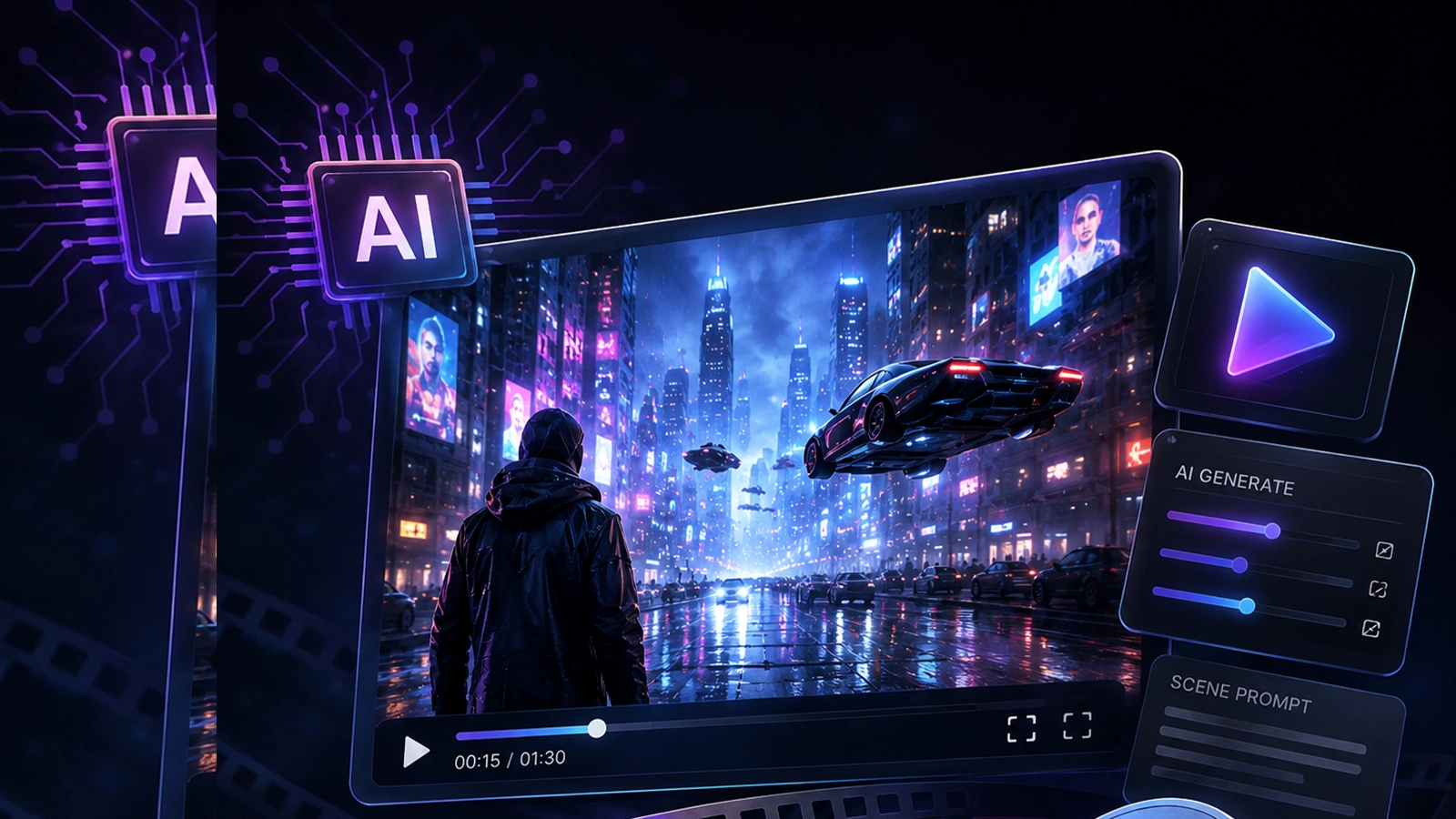
The strongest AI-assisted YouTube workflow is not “press generate and upload.” It is a repeatable production pipeline that combines original storytelling, visual planning, AI generation, editing, sound and human quality control.
- The complete AI YouTube pipeline
- 1. Start with an original idea
- 2. Write the script
- 3. Build the visual plan
- 4. Create reference assets
- 5. Generate the video
- 6. Add voice and sound
- 7. Edit and add VFX
- 8. Make the thumbnail and metadata
- 9. Quality control and AI disclosure
- How to keep an AI channel monetizable
- FAQ
The complete AI YouTube pipeline
Use AI to accelerate production, not eliminate authorship. Your channel becomes more defensible when viewers can identify a real point of view, original script, deliberate editing and a consistent creative identity.
1. Start with an original idea
Before opening an AI video generator, decide why someone would watch the video. The strongest starting points are questions, problems, stories, discoveries, comparisons and useful explanations.
For Zgian, examples include:
- How a famous movie VFX shot was created
- How AI video changes traditional VFX
- Explaining a CGI technique with visual examples
- Testing an AI video tool against a real production workflow
- Breaking down a movie creature or environment
The AI should help visualize the idea, not become the idea itself.
2. Write the script
Create the narration before generating large amounts of footage. This prevents the common problem of producing beautiful clips that do not support the story.
↓
PROMISE / QUESTION
↓
CONTEXT
↓
MAIN EXPLANATION
↓
VISUAL EXAMPLES
↓
KEY INSIGHT
↓
CONCLUSION / NEXT STEP
For educational videos, write one clear visual purpose for each paragraph. That makes the next storyboard step much faster.
3. Build the visual plan
Convert the script into shots. You do not need a perfect drawing; a shot list is enough.
| Time | Narration | Visual | AI/Production Method |
|---|---|---|---|
| 0:00–0:15 | Hook | Fast cinematic opening | Image-to-video |
| 0:15–0:40 | Question | Relevant environment | Generated background + edit |
| 0:40–2:00 | Explanation | Diagrams, examples, B-roll | AI + stock/owned assets |
| 2:00+ | Story / evidence | Purpose-built shots | AI video + traditional VFX |
4. Create reference assets
This is where our earlier character-consistency work becomes useful. Before generating a sequence, establish:
Identity, wardrobe and reference views.
Images
Approved keyframes and visual references.
Style
Camera, lighting, environment and VFX language.
Reference-first generation reduces unnecessary variation and makes it easier to build connected shots.
5. Generate the video
Generate short shots rather than trying to create the entire YouTube video in one pass. Use the tool that best fits each shot.
| Shot requirement | Useful approach |
|---|---|
| Existing character image | Image-to-video |
| New visual concept | Text-to-video or text-to-image → image-to-video |
| Real footage transformation | Video-to-video where supported |
| Technical VFX element | AI generation + traditional compositing |
Our earlier guides explain text-to-video and image-to-video in more detail.
6. Add voice and sound
Voice should serve the story. Whether you record your own voice or use synthetic narration, review pronunciation, pacing, emotion and synchronization.
Then add sound effects, ambience and music. Even strong AI visuals can feel amateurish when the audio is flat or disconnected from the action.
7. Edit and add VFX
The edit is where separate generations become one video. Remove weak frames, control pacing, add transitions only when they help, and use compositing to integrate generated elements.
For Zgian, this is a major differentiator: AI-generated footage should be treated as production material that an experienced VFX artist can shape, not as a final answer.
8. Make the thumbnail and metadata
The thumbnail and title should accurately communicate the video’s value. AI can help generate concepts, but human selection matters.
For SEO, align the title, description and opening content with the viewer’s search intent. Avoid stuffing keywords that do not match the actual video.
9. Quality control and AI disclosure
Before publishing, review the complete video from the viewer’s perspective.
- Is the opening clear in the first few seconds?
- Are there visual artifacts?
- Does the narration match the visuals?
- Are names and facts correct?
- Is the audio balanced?
- Are copyrighted or third-party assets used appropriately?
- Does the thumbnail represent the actual video?
- Does the video require YouTube’s AI disclosure?
YouTube currently requires creators to disclose AI-generated or meaningfully altered content when it appears realistic—for example, a realistic scene that never happened or a real person being shown doing something they did not do. Non-realistic animation and minor production assistance such as AI-generated scripts, outlines, captions, upscaling or idea generation generally do not require that disclosure.
YouTube also says disclosure itself does not reduce a video’s monetization eligibility or audience reach.
How do you keep an AI YouTube channel monetizable?
This is extremely important for Zgian’s long-term plan. YouTube’s current monetization policy says repetitive or mass-produced “inauthentic content” is not eligible for monetization. The policy applies regardless of how the content was made.
That does not mean AI videos are banned from monetization. YouTube has explicitly said AI-assisted storytelling can remain eligible when the channel follows its monetization rules.
| Better approach | Riskier approach |
|---|---|
| Original scripts and research | Automatically generated scripts with minimal changes |
| Distinct videos with different ideas | Dozens of near-identical template videos |
| Human editing and storytelling | One-click generation → upload |
| Useful commentary or education | Generic slideshow narration |
| Clear AI disclosure when required | Hiding realistic synthetic content |
For Zgian, this is actually good news. Our planned content is based on original VFX explanations, technical breakdowns, research and creative analysis. AI should visualize those ideas—not replace the editorial value.
Recommended Zgian production stack
This approach also makes the website and YouTube channel reinforce each other: the article can explain the technology, while the YouTube video demonstrates it.
How the Zgian website and YouTube channel can work together
| Website | YouTube |
|---|---|
| “What Is Image-to-Video AI?” | Visual demonstration of image-to-video |
| “Best AI Video Tools for VFX” | Tool test and comparison |
| “AI Character Consistency” | Before/after character consistency experiment |
| Movie VFX breakdown | Animated visual explanation |
This creates a strong search → article → video → subscriber → returning visitor loop.
Frequently asked questions
Can AI-generated YouTube videos be monetized?
Yes. YouTube says AI-assisted storytelling can remain eligible for monetization, but mass-produced or repetitive “inauthentic content” is not eligible. The final channel still needs original and authentic value.
Do I have to disclose AI-generated video on YouTube?
You must disclose AI-generated or meaningfully altered content when it appears realistic and could mislead viewers. Non-realistic animation and many minor production-assistance uses do not require disclosure.
Does the AI disclosure hurt YouTube monetization?
YouTube says making the required disclosure does not by itself limit audience reach or monetization eligibility.
Should I make an entire YouTube video with one AI video generator?
Usually not. A shot-based workflow is more controllable. Use different tools or traditional techniques when they are better suited to a particular shot.
What is the best AI workflow for a VFX-focused YouTube channel?
Use AI for visualization and production speed, but keep research, script direction, editing, VFX integration and quality control human-led. That combination gives the channel a stronger creative identity.
3D Generalist & VFX Professional · About the author →