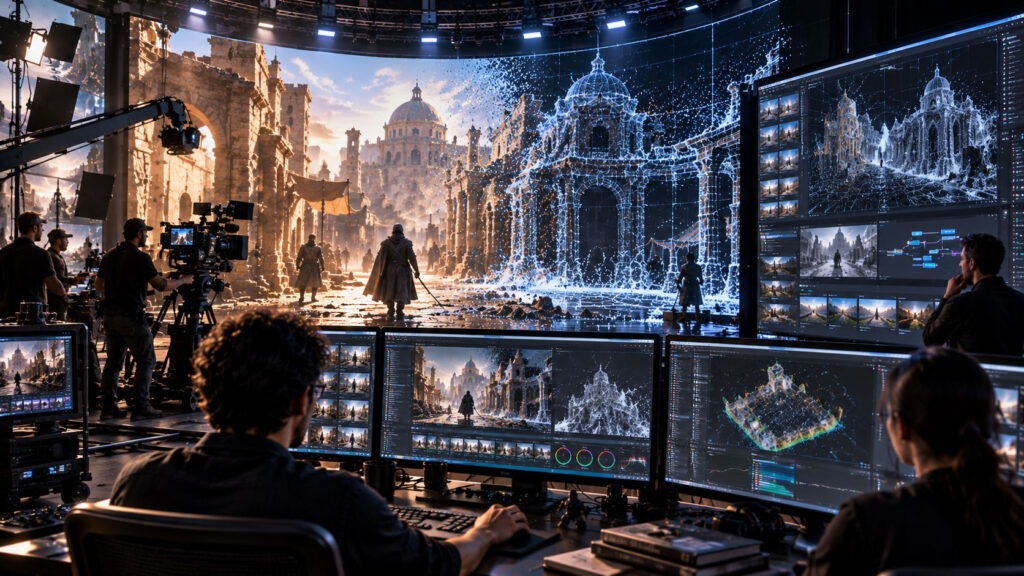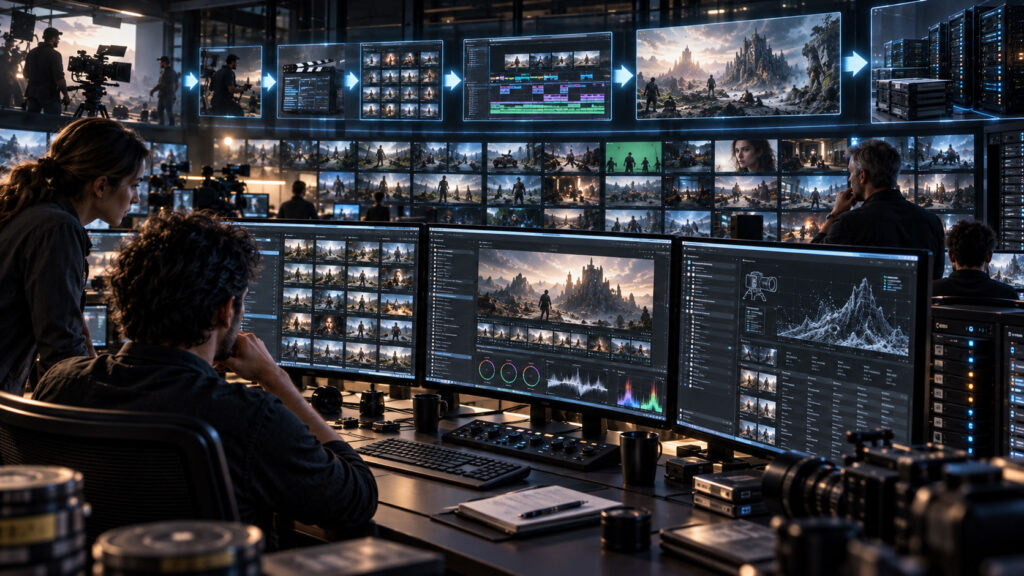
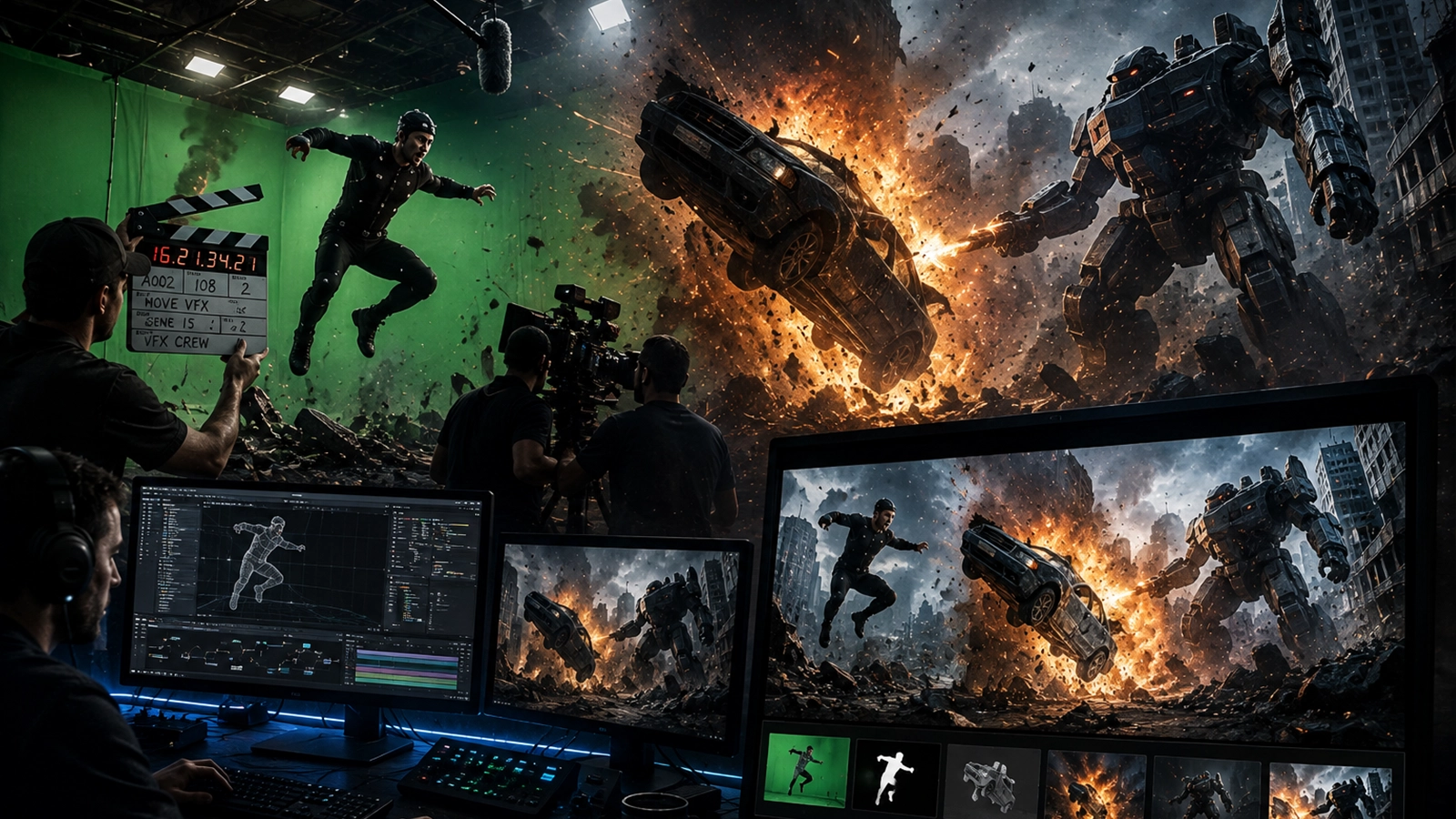
Modern VFX cleanup combines AI inpainting, tracking, clean-plate construction and traditional paint techniques to remove unwanted elements while preserving believable texture and motion.
1. What VFX cleanup is
VFX cleanup removes unwanted elements or repairs parts of a shot without making the alteration visible. It can be a tiny dust mark or a large object covering important background detail.
→ TARGET MASK
→ TRACK
→ CLEAN PLATE / AI RECONSTRUCTION
→ PATCH / BLEND
→ TEXTURE + GRAIN
→ TEMPORAL QC
→ CLEAN PLATE
The difficult part is reconstructing believable information, not merely hiding the unwanted object.
2. Common cleanup targets
| Target | Typical method |
|---|---|
| Wire / cable | Tracked paint or AI removal. |
| Tracking marker | Patch replacement or clean plate. |
| Rig / safety harness | Roto, paint and texture reconstruction. |
| Sign / logo | Patch, replacement or tracked graphic. |
| Person in background | AI object removal plus temporal repair. |
| Dust / blemish | Automated cleanup or frame-based paint. |
3. Clean plates
A clean plate is an image or sequence representing the background without the unwanted object. It can come from another frame, a separate camera pass, manually painted pixels or AI reconstruction.
| Source | Advantage | Risk |
|---|---|---|
| Adjacent frame | Real texture and lighting. | Camera or subject movement. |
| Clean-plate shoot | Best controlled reference. | Requires production planning. |
| Patch from nearby area | Fast for simple surfaces. | Repeating texture. |
| AI reconstruction | Useful when source pixels are missing. | Invented detail may drift. |
4. AI inpainting and reconstruction
AI inpainting predicts missing image content from surrounding context. It can be useful for walls, roads, skies and other repetitive environments, but it should be supervised carefully when the removed area contains structured objects.
→ MASK
→ AI INPAINT
→ COMPARE TO REFERENCE
→ CORRECT GEOMETRY
→ RESTORE TEXTURE
→ TEMPORAL CHECK
AI-generated pixels should be treated as a reconstruction that needs visual verification, not as guaranteed historical information from the original plate.
5. Tracking the cleanup
A cleanup patch that stays still while the camera moves will immediately reveal the effect. Track the target or the surface so the repair follows the shot.
| Surface | Useful tracking approach |
|---|---|
| Flat wall | Planar tracking. |
| Road / ground | Planar or camera-aware tracking. |
| Irregular object | Point/object tracking plus manual correction. |
| Handheld shot | Camera tracking and local patch stabilization. |
6. Patch replacement
Patch replacement copies suitable pixels from another region of the plate. It remains one of the most dependable cleanup methods when matching texture and lighting are available.
- Choose a source region with similar perspective.
- Track the patch to the target surface.
- Blend edges carefully.
- Match local brightness and color.
- Restore grain after compositing.
Use real plate pixels whenever they are available and appropriate. AI reconstruction is most valuable when the original shot does not contain enough usable information.
7. Wire, rig and marker removal
Wire removal is a classic cleanup task. The wire can cross skin, clothing, foliage, buildings or moving objects, so one global paint operation is rarely enough.
| Situation | Approach |
|---|---|
| Wire over simple sky | AI/paint reconstruction can be fast. |
| Wire over skin | Use tracked paint with texture and color matching. |
| Wire over moving foliage | Use multiple frames and temporal reconstruction. |
| Rig over detailed environment | Build a clean plate from several sources. |
8. Texture and grain restoration
After removal, the repaired region may look too smooth or too clean. Match texture frequency, grain, sharpness and local contrast to the original plate.
| Mismatch | Visible symptom |
|---|---|
| Too smooth | Painted patch becomes visible. |
| Wrong grain size | Patch has a different camera signature. |
| Wrong sharpness | Repair appears softer or sharper than surroundings. |
| Wrong contrast | Patch looks pasted on. |
9. Temporal consistency
The repaired pixels must remain stable over time. AI-generated texture can flicker, change shape or invent different details from frame to frame.
↕
FRAME N+1
↕
FRAME N+2
→ SAME STRUCTURE
→ SAME TEXTURE
→ SAME LIGHTING
→ NO FLICKER
Always inspect the repaired region in motion. A still frame can look perfect while the sequence reveals obvious temporal instability.
10. Integration
Cleanup is not finished until the repaired plate matches the rest of the image. Check color, focus, depth, grain, motion blur and atmosphere.
| Check | Question |
|---|---|
| Color | Does the repaired area match neighboring pixels? |
| Focus | Is sharpness consistent with the lens? |
| Motion | Does the repair move naturally with the shot? |
| Lighting | Does the reconstruction respond to changing light? |
| Grain | Does it share the same camera texture? |
Related workflows: AI VFX Cleanup, AI Rotoscoping 2.0 and AI Compositing.
11. Common mistakes
| Mistake | Why it fails | Better approach |
|---|---|---|
| One-frame AI removal | Creates flicker in a sequence. | Use temporal tracking and review. |
| Wrong patch source | Perspective or texture does not match. | Choose a structurally similar source. |
| Over-smoothing | Creates an obvious synthetic area. | Restore texture and grain. |
| Ignoring changing light | Patch brightness stays static. | Animate or reconstruct the lighting response. |
| No matte control | Removal affects surrounding pixels. | Use precise tracked masks. |
| Trusting AI geometry | AI may invent impossible structures. | Compare against plate references. |
12. Complete Zgian Cleanup 2.0 workflow
↓
DEFINE TARGET
↓
ROTO / MASK
↓
TRACK
↓
SOURCE REAL PIXELS
↓
AI INPAINT WHERE NEEDED
↓
PATCH / PAINT
↓
TEXTURE + COLOR MATCH
↓
GRAIN / SHARPNESS
↓
TEMPORAL QC
↓
FINAL CLEAN PLATE
- Identify exactly what must disappear.
- Track the affected surface.
- Search the plate for usable clean pixels.
- Build patches or a clean plate.
- Use AI reconstruction only where useful.
- Blend and restore texture.
- Match grain, focus and lighting.
- Review the whole shot in motion.
13. Final cleanup QC
- Check the removed object is completely gone.
- Check edges of the repaired area.
- Check texture continuity.
- Check perspective and tracking.
- Check changing illumination.
- Check motion blur.
- Check temporal flicker.
- Check grain and sharpness.
- Check the repair at full resolution.
- Review the final shot, not only the cleanup node.
How this fits the Zgian VFX + AI pipeline
AI ROTO → AI Rotoscoping 2.0
AI CLEANUP 1.0 → AI VFX Cleanup
AI CLEANUP 2.0 → this guide
AI KEYING → AI Green Screen
AI COMP → AI Compositing
Frequently asked questions
What is AI VFX cleanup?
It is the use of AI-assisted segmentation, inpainting, tracking or reconstruction to remove unwanted elements and repair image areas in VFX footage.
Can AI remove a person from a video?
AI can assist with person removal, but reliable results depend on camera movement, background visibility, occlusion and temporal consistency.
What is a clean plate?
A clean plate is a version of the shot containing the desired background without the unwanted object.
Why does AI object removal flicker?
Frame-by-frame reconstruction can generate slightly different pixels each frame. Temporal tracking and consistency checks are needed to stabilize the repair.
Is AI cleanup better than traditional paint?
Not universally. AI is valuable for speed and difficult reconstruction, while traditional paint provides precise artist control. Hybrid workflows are often strongest.
Continue the Zgian VFX + AI series
3D Generalist & VFX Professional · About the author →