A clean key is not simply a background-removal problem. Professional green screen work requires matte design, hair detail, edge control, spill suppression, tracking and image integration.
- What keying actually does
- Green screen plate preparation
- Primary key
- Where AI helps
- Hair and semi-transparent detail
- Green spill removal
- Edge refinement
- Roto and garbage mattes
- Despill and color recovery
- Background compositing
- Tools and workflow choices
- Common mistakes
- Complete workflow
- Final QC
- FAQ
1. What keying actually does
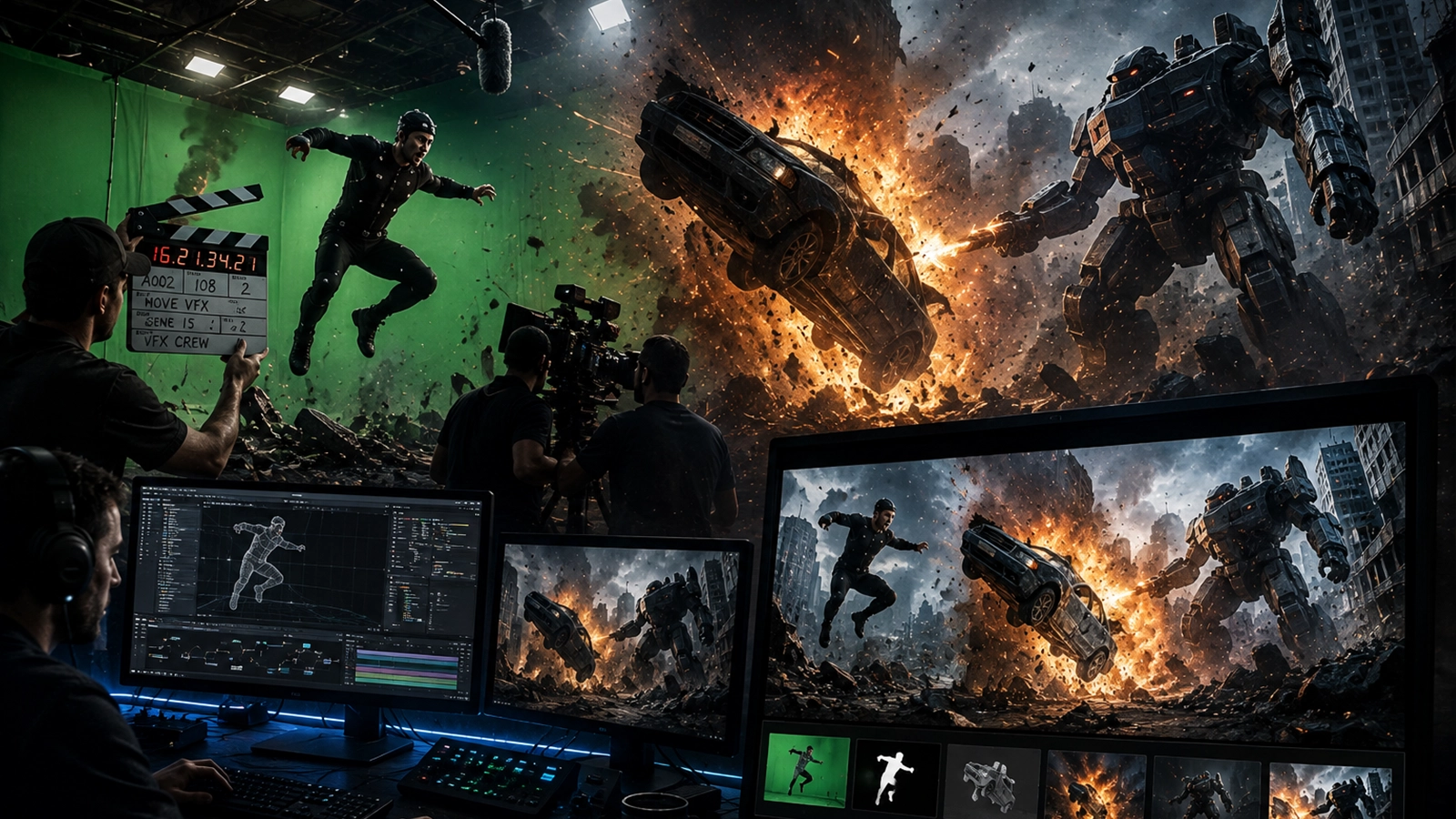
Keying separates a foreground subject from a colored background by estimating which pixels belong to the background and which belong to the subject. The result is a matte that can be used to combine the foreground with another image.
→ KEY / AI MATTE
→ MATTE CLEANUP
→ EDGE / HAIR DETAIL
→ DESPILL
→ COLOR MATCH
→ COMPOSITE
A good key preserves natural edges and semi-transparent areas while removing the background cleanly.
2. Green screen plate preparation
The quality of the source plate strongly affects the key. Before running any AI or traditional keyer, inspect exposure, focus, motion blur, compression and screen uniformity.
| Plate issue | Effect on key | Response |
|---|---|---|
| Uneven green | Matte holes and patches. | Use multiple key ranges or pre-correct the plate. |
| Heavy shadows | Foreground/background separation becomes difficult. | Use secondary keys and roto. |
| Motion blur | Edges become semi-transparent. | Preserve motion-blurred regions deliberately. |
| Compression | Color edges become contaminated. | Use restoration and careful matte extraction. |
| Fine hair | Hair detail disappears. | Use dedicated hair/soft-edge treatment. |
3. Primary key
The primary key should establish the broad foreground/background separation. It should not try to solve every hair, reflection or transparent edge in one operation.
→ SOLID FOREGROUND
→ CLEAN BACKGROUND
→ HOLDOUTS
→ SECONDARY DETAIL KEYS
Keep the main matte stable. Add targeted keys for problem regions rather than constantly changing the global threshold.
4. Where AI helps
AI matting systems can estimate foreground transparency from visual context, helping with complex edges and subjects that are difficult to separate using color alone.
| AI task | Useful for |
|---|---|
| AI matting | Foreground alpha estimation. |
| Subject segmentation | Initial isolation and holdout creation. |
| Hair segmentation | Fine edge recovery. |
| Temporal propagation | Maintaining a matte across frames. |
| Object tracking | Keeping masks attached to moving subjects. |
AI can accelerate the first pass, but difficult shots still benefit from artist-guided mattes and traditional keying.
5. Hair and semi-transparent detail
Hair is one of the classic tests of a key because individual strands may contain a mixture of foreground color, green spill and background pixels.
- Create a dedicated hair matte where necessary.
- Preserve motion-blurred strands rather than sharpening them artificially.
- Use background-aware edge colors.
- Separate solid hair from fine flyaways.
- Review hair against both light and dark backgrounds.
Preview the matte over black, white and the final background. A matte that looks perfect on one background can reveal problems immediately on another.
6. Green spill removal
Green spill occurs when the screen reflects green light onto the actor, especially around hair, shoulders and reflective materials. Removing it requires more than simply desaturating green.
| Spill area | Recommended treatment |
|---|---|
| Hair edge | Targeted despill with edge preservation. |
| Skin | Selective color correction; avoid gray skin. |
| Clothing | Mask and restore original material color where possible. |
| Reflective object | Analyze whether green is real reflection or unwanted spill. |
7. Edge refinement
Edge treatment determines whether a composite feels photographic. Avoid making every edge equally sharp.
| Edge characteristic | Match to plate |
|---|---|
| Static sharp edge | Preserve appropriate detail. |
| Motion-blurred edge | Retain the original blur. |
| Soft focus edge | Do not over-sharpen. |
| Fine hair | Use soft alpha transitions. |
| Defocused foreground | Match depth-of-field behavior. |
8. Roto and garbage mattes
Rotoscoping remains valuable even in an AI-assisted workflow. A simple garbage matte can prevent the keyer from wasting effort on large areas of the image that never need to be keyed.
Use AI Rotoscoping & Masking for targeted subject isolation and manual correction where the shot requires it.
9. Despill and color recovery
After the matte is stable, restore believable foreground color. Despill should remove contamination without destroying the original material response.
→ SPILL DETECTION
→ SELECTIVE DESPILL
→ SKIN / MATERIAL RECOVERY
→ EDGE COLOR REPAIR
→ FINAL FG
Compare the processed foreground with the original plate regularly. The goal is not to remove every trace of green at any cost; it is to create a foreground that belongs in the new environment.
10. Background compositing
A technically perfect matte can still look wrong if the background does not match. Match perspective, scale, focus, grain, color, lighting and atmosphere.
| Integration element | What to match |
|---|---|
| Perspective | Camera angle and lens. |
| Depth of field | Focus distance and blur. |
| Lighting | Direction, softness and exposure. |
| Atmosphere | Haze, depth and color shift. |
| Grain | Camera noise characteristics. |
| Motion blur | Shutter and movement. |
See AI Compositing and AI Motion Blur for related finishing techniques.
11. Tools and workflow choices
| Category | Typical role |
|---|---|
| Traditional keyer | Color-based primary extraction. |
| AI matting | Context-aware foreground estimation. |
| Roto tools | Holdouts, garbage mattes and difficult regions. |
| Edge tools | Choke, soften, erode and edge color management. |
| Compositor | Despill, integration and final grade. |
Use the simplest combination that gives you stable control. AI is an accelerator, not a reason to remove every artist-controlled stage.
12. Common mistakes
| Mistake | Why it fails | Better approach |
|---|---|---|
| One-click key | Fine detail and difficult areas are lost. | Use primary, secondary and roto mattes. |
| Over-choked edges | Hair and natural contours disappear. | Refine different edge classes separately. |
| Heavy despill | Skin and materials become gray. | Use selective color recovery. |
| Ignoring motion blur | Foreground looks cut out. | Preserve or recreate plate blur. |
| No background matching | Subject appears pasted on. | Match light, focus, grain and atmosphere. |
| Judging only on checkerboard | Integration problems remain hidden. | Review over the final background. |
13. Complete Zgian AI keying workflow
↓
GARBAGE MATTE
↓
PRIMARY KEY
↓
AI MATTE / SECONDARY KEYS
↓
HAIR + TRANSPARENCY
↓
ROTO HOLDOUTS
↓
EDGE REFINEMENT
↓
DESPILL
↓
BACKGROUND MATCH
↓
COLOR / GRAIN / ATMOSPHERE
↓
TEMPORAL QC
↓
FINAL MASTER
- Inspect the plate and identify difficult areas.
- Create garbage mattes and holdouts.
- Build the primary key.
- Use AI matting for difficult regions.
- Recover hair and transparency.
- Refine edges and remove spill.
- Composite against the final environment.
- Match focus, motion blur, grain and atmosphere.
- Review the shot at full speed.
14. Final green-screen QC
- Check solid foreground areas.
- Check fine hair.
- Check semi-transparent objects.
- Check motion-blurred edges.
- Check green spill.
- Check matte chatter and flicker.
- Check edge color.
- Check shadows and reflections.
- Check background integration.
- Review the final master, not only the matte.
How this fits the Zgian VFX + AI pipeline
AI ROTO → AI Rotoscoping
AI KEYING → this guide
AI CLEANUP → AI VFX Cleanup
AI COMP → AI Compositing
AI DIGITAL HUMANS → Digital Humans
Frequently asked questions
Can AI remove a green screen automatically?
AI can create a useful initial matte, but professional shots often need artist-guided keying, roto, hair recovery, despill and temporal cleanup.
Why is hair difficult to key?
Fine hair contains semi-transparent pixels, motion blur and reflected green light, so a simple binary matte cannot represent it accurately.
What is spill suppression?
Spill suppression reduces unwanted green light reflected from the screen onto the foreground while preserving the subject’s natural material colors.
Should I use AI or a traditional keyer?
Use whichever provides the most stable control. A hybrid workflow often works best: traditional keying for the broad matte and AI/roto for difficult detail.
Why does my keyed subject look cut out?
Common causes are incorrect edge softness, missing motion blur, poor despill, mismatched lighting, sharpness or grain, and an inconsistent background.
Continue the Zgian VFX + AI series
3D Generalist & VFX Professional · About the author →