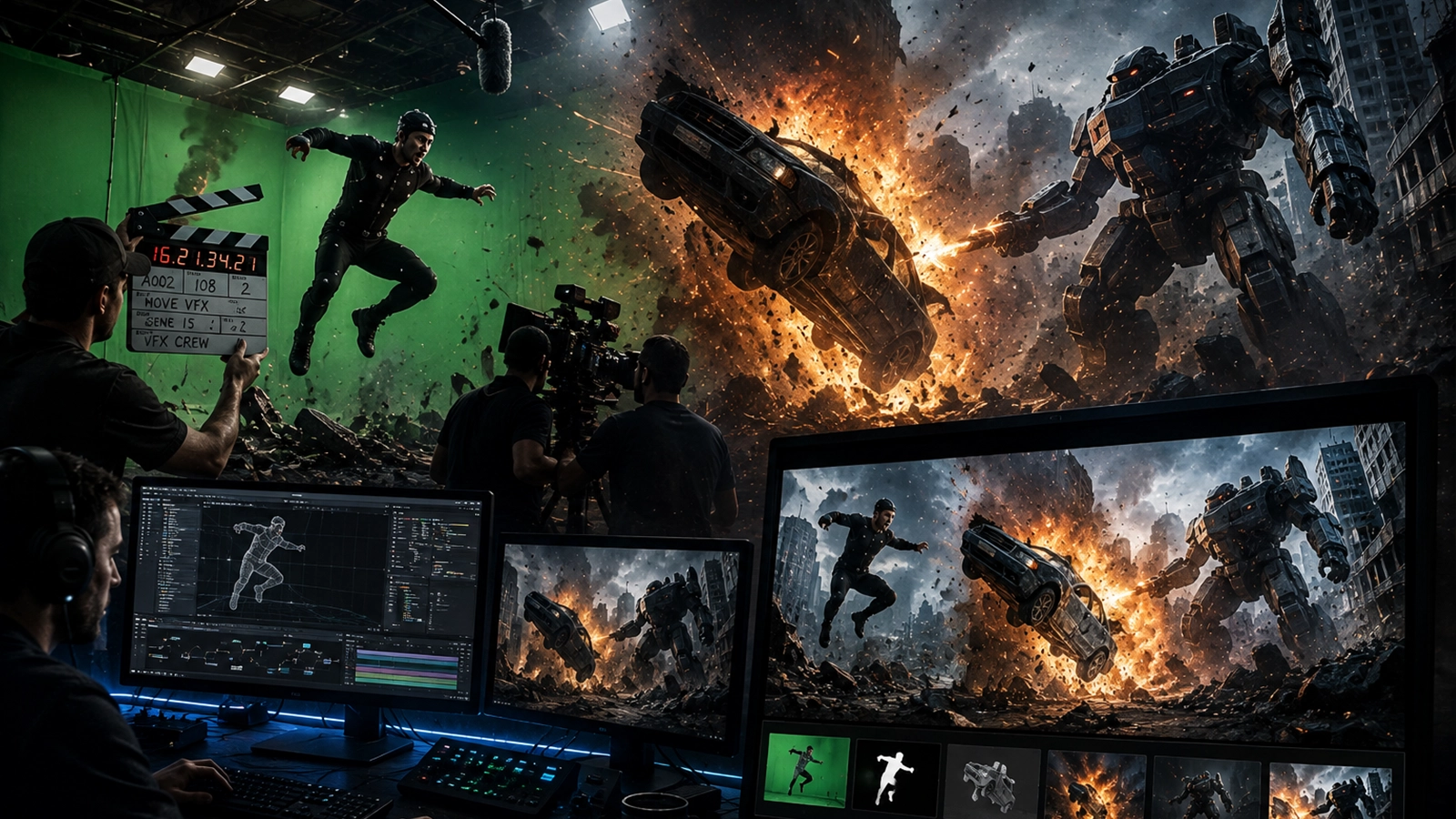
Digital humans combine modeling, rigging, facial performance, rendering and compositing. AI can accelerate parts of the pipeline, but believable identity still depends on anatomy, motion, lighting and careful temporal consistency.
- What is a digital human?
- Digital doubles
- Face replacement
- Facial performance capture
- AI lip sync
- Body and character animation
- Skin, hair and eyes
- Camera and tracking
- Compositing the digital human
- AI and character tools
- Identity, consent and responsible use
- Complete workflow
- Common mistakes
- Final QC
- FAQ
1. What is a digital human?
A digital human is a computer-generated or digitally modified person designed to perform convincingly on screen. The character can be fully synthetic, a digital double of a performer, or a hybrid in which only selected facial or body elements are replaced.
→ CHARACTER BUILD
→ FACE + BODY
→ ANIMATION
→ SKIN / HAIR / EYES
→ LIGHTING
→ COMPOSITING
→ FINAL DIGITAL HUMAN
Believability comes from consistency across many systems. A perfect face with poor motion still looks artificial.
2. Digital doubles
A digital double is a digital representation of a performer or real person. Doubles may be used for dangerous action, impossible camera moves, crowd multiplication, age changes, background replacement or shots where the performer cannot physically be present.
| Double type | Typical use | Complexity |
|---|---|---|
| Body double | Stunts and wide shots. | Medium |
| Facial double | Face replacement or performance enhancement. | High |
| Full digital double | Hero CG character. | Very high |
| Background double | Crowds and distant characters. | Lower |
3. Face replacement
AI face replacement can transfer or reconstruct facial identity, but professional VFX requires accurate tracking, lighting, expression and temporal stability.
| Stage | Purpose |
|---|---|
| Face detection / tracking | Find the facial region and its motion. |
| Roto / matte | Define exactly where replacement is allowed. |
| Identity transfer | Generate or map the target facial appearance. |
| Expression matching | Preserve the original performance. |
| Color / texture match | Integrate the face with the plate. |
| Temporal cleanup | Remove flicker, warping and identity drift. |
For fictional or consented productions, AI face replacement can be a powerful VFX technique. For real people, identity and consent requirements should be established before generation or publication.
4. Facial performance capture
Facial capture records expressions so a digital character can reproduce a performer’s performance. Systems may use cameras, markers, depth sensing or image-based tracking.
- Capture a neutral facial reference.
- Record the performance with consistent camera conditions.
- Track facial landmarks or performance signals.
- Map captured movement to the character rig.
- Clean noisy or impossible facial motion.
- Review expressions at full speed.
Do not let facial technology destroy the actor’s performance. Preserve timing, intent and expression whenever the shot requires a real performance.
5. AI lip sync
AI lip-sync systems can generate mouth movement from dialogue or alter timing. They are useful for animation, localization and controlled character work, but mouth motion must still match the character’s anatomy, emotion and head movement.
| Requirement | QC question |
|---|---|
| Timing | Does the mouth open on the correct phoneme? |
| Emotion | Does the expression match the dialogue? |
| Jaw motion | Does the mouth movement follow the head? |
| Teeth / tongue | Do internal mouth details remain stable? |
| Lighting | Do mouth and skin share the same light? |
6. Body and character animation
A digital human needs convincing body mechanics as well as a convincing face. AI motion generation can accelerate blocking, while traditional animation and cleanup remain important for hero performances.
→ AI / MOTION CAPTURE
→ RETARGET
→ CLEANUP
→ KEYFRAME REFINEMENT
→ FINAL CHARACTER MOTION
For stylized characters, physical accuracy can be intentionally altered. For photoreal humans, small timing and weight errors become highly visible.
7. Skin, hair and eyes
Skin, hair and eyes are major contributors to realism because viewers are extremely sensitive to them.
| Element | Important details |
|---|---|
| Skin | Subsurface response, pores, roughness and color variation. |
| Eyes | Wetness, reflections, cornea, iris detail and gaze. |
| Hair | Direction, density, flyaways and light response. |
| Lips | Moisture, texture and natural deformation. |
| Teeth | Shape, color and contact with lips. |
8. Camera and tracking
The digital human must live inside the same camera as the plate. Camera tracking, facial tracking, body tracking and lens characteristics all contribute to believable integration.
→ CAMERA TRACK
→ FACE / BODY TRACK
→ DIGITAL CHARACTER
→ MATCH LENS
→ MATCH MOTION BLUR
→ COMPOSITE
See AI Motion Tracking for camera and object tracking, and AI Motion Blur for temporal finishing.
9. Compositing the digital human
Even a strong digital character can look artificial if compositing ignores the plate’s image characteristics.
| Composite stage | Purpose |
|---|---|
| Edge integration | Match softness, motion blur and hair edges. |
| Color matching | Match skin and environment. |
| Depth / atmosphere | Place character into the scene. |
| Shadows | Ground the character. |
| Reflections | Connect character to reflective surfaces. |
| Grain / noise | Match the camera image. |
Our AI Compositing guide covers the broader integration process.
10. AI and character tools
| Category | Role |
|---|---|
| 3D character tools | Modeling, rigging and digital-human construction. |
| Facial capture | Performance acquisition and retargeting. |
| AI face systems | Identity transfer and face replacement. |
| AI lip sync | Dialogue-driven facial animation. |
| Motion generation | Body animation and blocking. |
| Rendering | Skin, hair, eyes and realistic lighting. |
| Compositing | Final integration and cleanup. |
The tools evolve rapidly. For production, prioritize controllable assets, versioned source material and a workflow that lets artists correct AI output.
11. Identity, consent and responsible use
Digital-human technology can reproduce a person’s face, voice or likeness. Production teams should establish permission and intended use before creating or distributing likeness-based content.
| Question | Production practice |
|---|---|
| Whose likeness? | Identify the performer or rights holder. |
| What is being changed? | Document face, voice, body or performance modifications. |
| Where will it be used? | Define distribution and audience. |
| Who approves? | Use clear production and rights approvals. |
| How is it disclosed? | Follow applicable production, platform and legal requirements. |
12. Complete Zgian digital-human workflow
↓
REFERENCE + PERFORMANCE
↓
DIGITAL DOUBLE / CHARACTER
↓
FACE + BODY RIG
↓
CAPTURE / AI ANIMATION
↓
FACIAL + BODY CLEANUP
↓
SKIN / HAIR / EYES
↓
CAMERA + LIGHT MATCH
↓
RENDER
↓
COMPOSITE
↓
TEMPORAL / IDENTITY QC
↓
FINAL MASTER
- Define why a digital human is needed.
- Collect appropriate reference and performance data.
- Build or prepare the character.
- Capture or generate facial and body performance.
- Clean the animation.
- Match camera, lighting and materials.
- Render the character.
- Composite into the plate.
- Check identity, motion and temporal consistency.
13. Common mistakes
| Mistake | Why it fails | Better approach |
|---|---|---|
| Perfect face, wrong expression | Identity looks disconnected from performance. | Preserve facial timing and emotion. |
| Static eyes | Human gaze is highly noticeable. | Animate gaze, reflections and micro-movement. |
| Perfect skin | Looks synthetic. | Use realistic variation and texture. |
| Wrong motion blur | Character appears composited. | Match camera shutter characteristics. |
| Face drift | Identity changes across frames. | Track and stabilize the facial solution. |
| Ignoring hair | Edges reveal the replacement. | Roto, render and composite hair carefully. |
14. Final digital-human QC
- Check identity consistency.
- Check facial performance.
- Check lip sync.
- Check eye direction and reflections.
- Check skin and hair detail.
- Check camera and perspective.
- Check motion blur.
- Check shadows and reflections.
- Check temporal stability.
- Watch the final shot at normal speed.
How this fits the Zgian VFX + AI pipeline
AI TRACKING → AI Motion Tracking
AI ROTO → AI Rotoscoping
AI CLEANUP → AI VFX Cleanup
AI COMP → AI Compositing
DIGITAL HUMANS → this guide
Frequently asked questions
What is an AI digital human?
An AI digital human is a digitally created or modified person whose appearance, performance or animation uses AI-assisted techniques within a broader character/VFX pipeline.
What is a digital double?
A digital double is a digital representation of a performer or real person, used for situations such as stunts, impossible camera shots, crowds or selected VFX replacements.
Can AI replace a real actor?
AI can reproduce or modify aspects of a performance, but production, creative, ethical and rights considerations are separate from the technical capability.
Why do digital humans enter the uncanny valley?
Small errors in eyes, skin, facial timing, gaze, mouth movement, hair or lighting can make a digital human feel artificial even when the model looks highly detailed.
Is face replacement the same as a digital double?
No. Face replacement may modify only the face in a live-action plate, while a digital double can represent the whole character or body.
Continue the Zgian VFX + AI series
3D Generalist & VFX Professional · About the author →