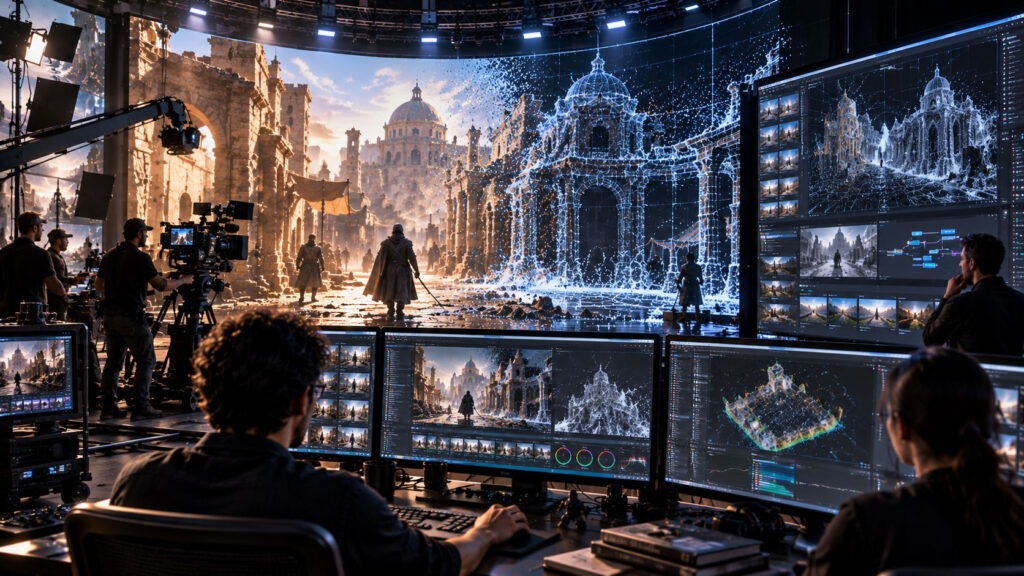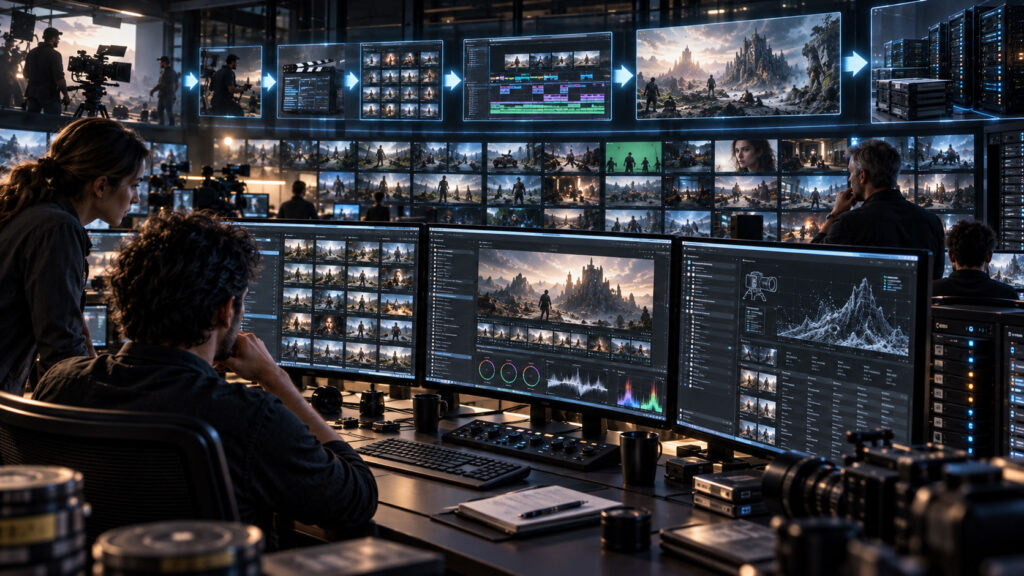
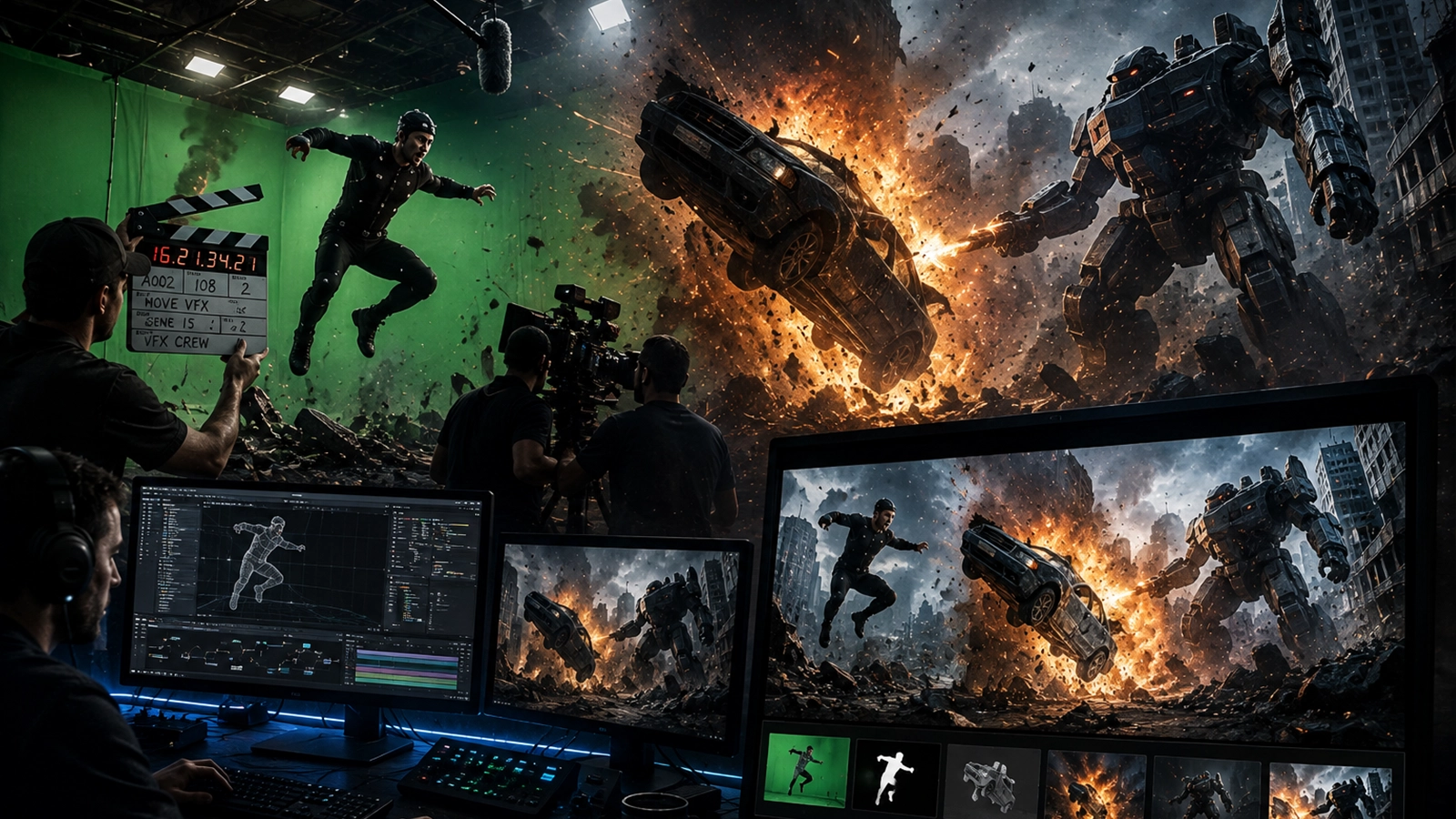
Virtual production brings digital environments onto the stage while the camera is rolling. AI can accelerate environment creation and look development, while real-time engines, tracking and LED calibration make the illusion work on set.
1. What virtual production means
Virtual production blends live-action filmmaking with digital environments and real-time technology. Instead of waiting until post-production to see every background, filmmakers can photograph actors against a visible digital world and capture useful lighting and reflections during the shoot.
+ ACTOR / PROP
+ TRACKED CAMERA
+ REAL-TIME 3D WORLD
+ LED DISPLAY
+ INTERACTIVE LIGHT
= IN-CAMERA VFX
Some virtual production uses LED walls, while other workflows use green screen, projection or mixed approaches. The key idea is to move selected visual decisions earlier into production.
2. What ICVFX is
In-camera visual effects (ICVFX) are effects captured directly by the camera during production. LED volume stages are a major example: a tracked camera views a rendered environment on surrounding LED panels, creating perspective-correct imagery in camera.
| Benefit | Why filmmakers use it |
|---|---|
| Visible environment | Actors and crew can see the world while shooting. |
| Interactive light | Environment color and brightness can illuminate subjects. |
| Reflections | LED content can appear naturally in reflective surfaces. |
| Final-pixel potential | Some background work is captured directly. |
| Creative iteration | Environment changes can happen without rebuilding a physical set. |
3. How LED walls work
An LED stage displays a digital environment around the physical set. The display is not simply a flat movie screen; the rendered view must respond to camera movement so perspective changes correctly.
| Component | Role |
|---|---|
| LED panels | Display the digital environment. |
| Media/render server | Feeds real-time imagery to the stage. |
| Camera tracking | Provides camera position and orientation. |
| Real-time engine | Renders the environment from the camera view. |
| Lens/camera calibration | Helps match physical and virtual camera behavior. |
| Lighting control | Supports exposure and interactive illumination. |
4. Where AI fits into virtual production
AI is especially useful before and around the real-time stage. It can accelerate concept art, environment ideation, texture generation, set dressing ideas, background variations, reference creation and some content-production tasks.
| Stage | AI opportunity |
|---|---|
| Pre-production | Concept art, mood exploration and environment variations. |
| Environment creation | Reference, textures, props and set-dressing concepts. |
| Look development | Rapid visual alternatives. |
| Post-production | Cleanup, extension, matte generation and finishing assistance. |
AI should support a controlled digital asset pipeline rather than becoming an uncontrolled source of random backgrounds.
5. Building digital environments
A virtual environment needs more than a pretty panoramic image. It must survive camera movement, perspective changes and lighting requirements.
Environment checklist
- Correct scale and proportions.
- Enough detail near the camera.
- Consistent lighting direction.
- Usable depth for parallax.
- Clean horizon and set boundaries.
- Optimized geometry and textures for real-time playback.
- Alternative versions for different shots.
Build the environment for the camera, not just for a still image.
6. Camera tracking and perspective
Camera tracking is fundamental. The virtual camera must respond to the physical camera so the environment changes with the same perspective.
→ TRACKING DATA
→ VIRTUAL CAMERA
→ REAL-TIME RENDER
→ LED WALL
→ PHYSICAL LENS IMAGE
Lens calibration, camera height, field of view and tracking accuracy all affect the final result. See the AI Motion Tracking guide for the broader tracking workflow.
7. Interactive lighting
One of the major advantages of LED-based production is that the displayed environment can contribute to the light seen on the actor and physical set. However, LED light alone may not reproduce every required lighting condition.
| Lighting element | Production approach |
|---|---|
| Environment color | Let LED content provide ambient influence. |
| Strong key light | Use physical fixtures when precision is required. |
| Fire/explosion | Combine LED animation with physical interactive light. |
| Sunlight | Use controlled physical key plus environment. |
| Night scenes | LED environment can provide color and practical context. |
8. Real-time engines
Real-time engines such as Unreal Engine are commonly used to build and render interactive virtual environments. The engine needs to deliver the correct viewpoint fast enough for the physical camera and display system.
The environment should be optimized for real-time performance: appropriate geometry, textures, lighting and level-of-detail systems matter as much as visual quality.
9. On-set virtual production workflow
- Calibrate the stage and cameras.
- Load the approved digital environment.
- Verify camera tracking.
- Check lens and perspective alignment.
- Set exposure and LED brightness.
- Balance practical and interactive lighting.
- Run camera and actor tests.
- Record the approved takes and metadata.
- Flag shots requiring additional post VFX.
Virtual production does not eliminate post-production. It changes what is captured on set and what remains to be finished later.
10. Post-production workflow
Even an ICVFX shot can require cleanup, edge work, set extension, reflection repair, color matching and additional effects.
→ CLEANUP
→ ROTO / MATTE
→ TRACKING
→ EXTRA CG / FX
→ COLOR / ATMOSPHERE
→ GRAIN
→ FINAL MASTER
Our AI VFX Cleanup and AI Compositing guides cover the post-production stages.
11. Tools and pipeline choices
| Category | Typical role |
|---|---|
| Unreal Engine | Real-time environment and virtual camera rendering. |
| LED display system | Physical in-camera environment. |
| Camera tracking | Synchronizes physical and virtual cameras. |
| 3D content tools | Environment, asset and lighting preparation. |
| AI generation tools | Concepts, textures, references and content variations. |
| Compositing software | Cleanup and final VFX integration. |
Tool capabilities and integrations evolve quickly, so a professional pipeline should be designed around stable deliverables and interoperability rather than a single software feature.
12. Common virtual production mistakes
| Mistake | Why it fails | Better approach |
|---|---|---|
| Pretty but shallow environment | Parallax reveals the trick. | Build depth for camera movement. |
| Incorrect camera tracking | Background slides. | Calibrate and validate tracking. |
| LED-only lighting | Light may lack required direction/intensity. | Combine LED with physical fixtures. |
| Overloaded real-time scene | Playback becomes unstable. | Optimize geometry, textures and rendering. |
| No post plan | Small on-set issues become expensive. | Define post VFX and plate requirements before shooting. |
| AI-generated environment without consistency | Details change between shots. | Build a controlled asset library. |
13. Complete Zgian AI virtual production workflow
↓
AI CONCEPT + ENVIRONMENT IDEATION
↓
3D ENVIRONMENT
↓
REAL-TIME OPTIMIZATION
↓
CAMERA / LENS CALIBRATION
↓
TRACKING
↓
LED / ICVFX SHOOT
↓
POST CLEANUP
↓
EXTRA CG / FX
↓
COLOR / FINISH
↓
FINAL QC
- Design the shot around the camera.
- Create and approve the digital environment.
- Optimize it for real-time playback.
- Calibrate camera, lens and tracking.
- Test perspective and parallax.
- Balance LED and physical lighting.
- Shoot approved takes with metadata.
- Complete remaining VFX in post.
- Perform final color and temporal QC.
14. Final virtual production QC
- Check camera tracking.
- Check perspective and parallax.
- Check LED exposure and artifacts.
- Check reflections.
- Check interactive lighting.
- Check actor/environment edge integration.
- Check remaining post VFX.
- Check color and grain consistency.
- Check final delivery master.
How this fits the Zgian VFX + AI pipeline
AI TRACKING → AI Motion Tracking
AI SIMULATION → AI VFX Simulation
AI ROTO → AI Rotoscoping
AI COMP → AI Compositing
VIRTUAL PRODUCTION → this guide
Frequently asked questions
What is AI virtual production?
It is virtual production enhanced with AI-assisted environment creation, look development, asset generation and post-production workflows.
What is an LED volume?
An LED volume is a production stage using large LED displays to show digital environments around performers, often combined with camera tracking and real-time rendering.
Does virtual production eliminate green screen?
No. Green screen, LED stages and hybrid approaches can all be useful. The best choice depends on the shot, environment, reflections, lighting and production requirements.
Why is camera tracking important for LED walls?
The virtual environment must change perspective with the physical camera. Accurate tracking keeps the digital world visually locked to the real camera movement.
Can AI create a complete virtual set?
AI can accelerate concepts and content creation, but a production-ready virtual set still needs scale, depth, optimization, consistency, camera integration and lighting control.
Continue the Zgian VFX + AI series
3D Generalist & VFX Professional · About the author →
Related Zgian Coverage
- XGRIDS Brings 3D Gaussian Splatting Into Unreal Engine for Virtual Production
- Colorfront and Qumulo Make VFX Footage Searchable With AI
- Gnomon Best of Term Showcases the Next Generation of VFX and CG Artists
- IBC 2026 Shows How AI Agents Are Automating Media Localization at Scale
- Zerply Is Shutting Down: What VFX Artists Need to Do Before September 28
- Reuters Brings AI-Assisted Video Editing to Newsrooms With CuttingRoom
- Adobe Adds AI Video Generation and AI Assistant to Premiere Pro and After Effects
- How Milk VFX Used Unreal Engine to Build the Lost Worlds of Surviving Earth
- Prime Video Uses AI and VFX to Improve Lip-Sync for Dubbing