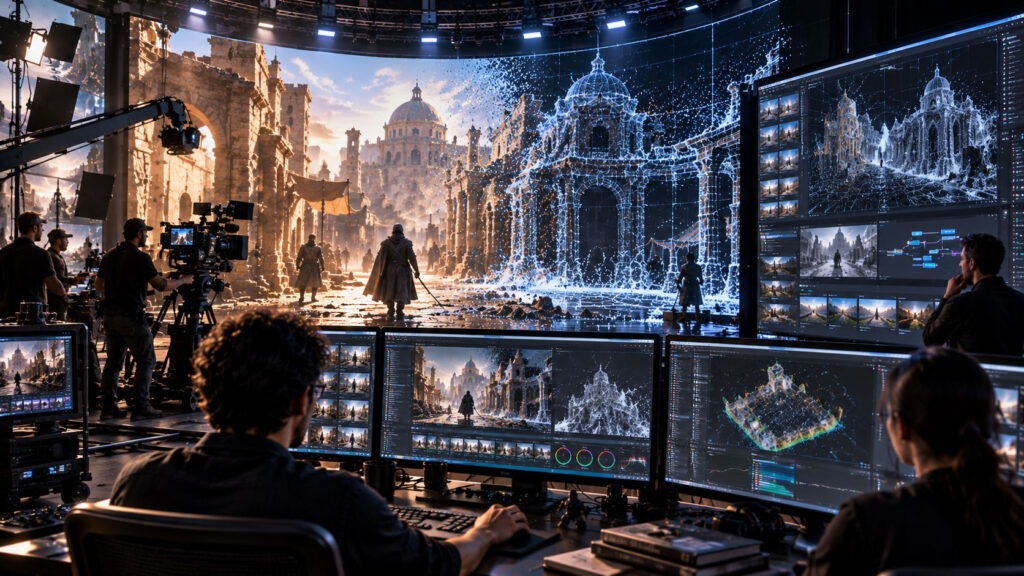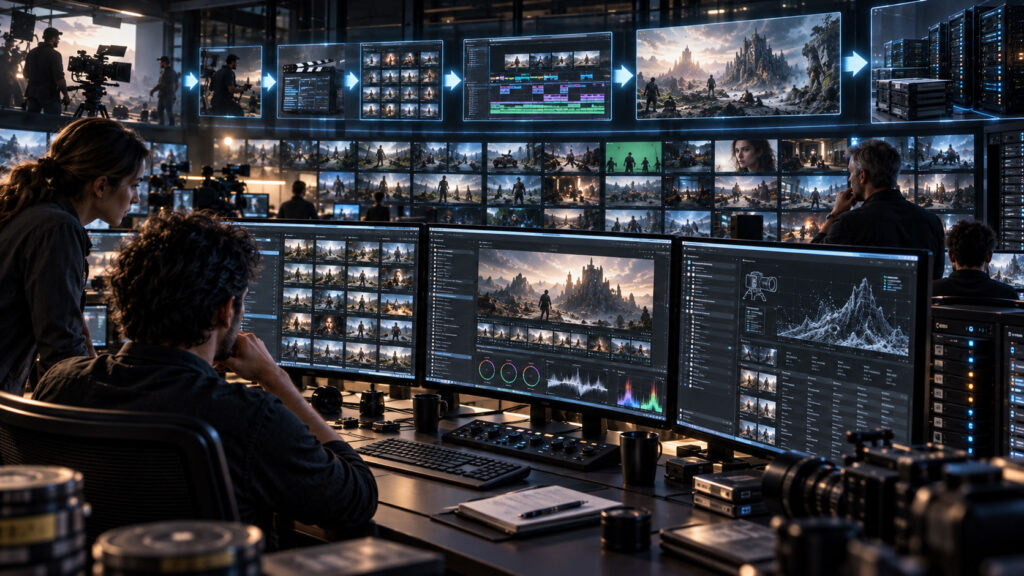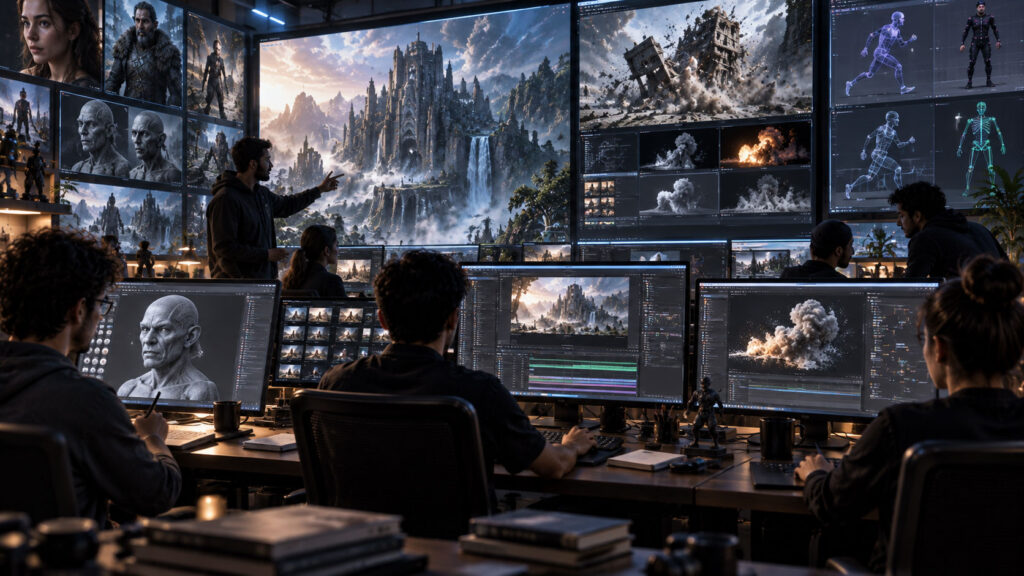
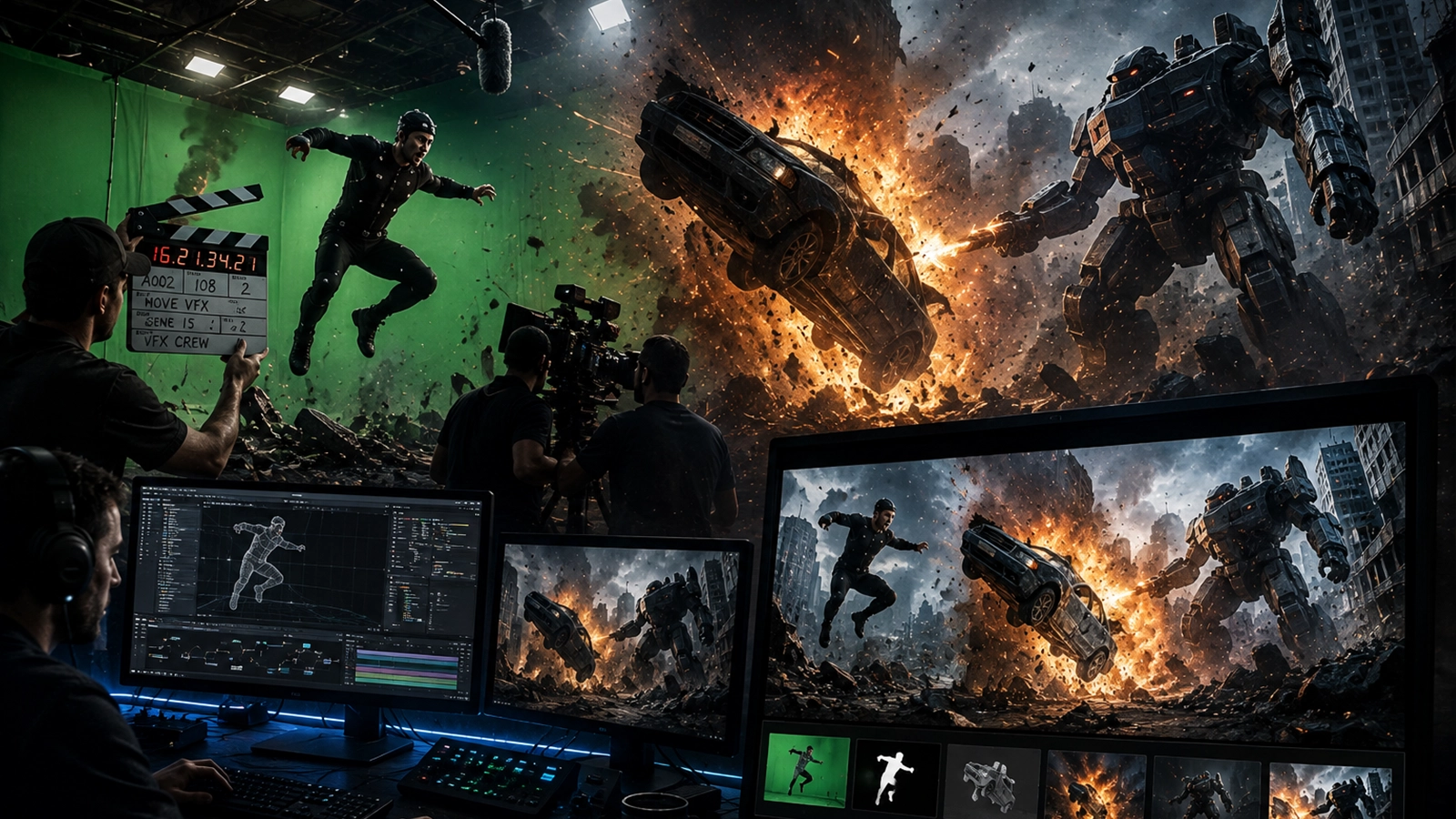
Tracking connects the photographed world to the digital world. AI can accelerate feature detection and track cleanup, but a reliable VFX track must reproduce camera motion, object movement, lens behavior and scene relationships throughout the entire shot.
- What AI tracking changes
- 2D motion tracking
- Planar tracking
- 3D camera tracking
- Object tracking
- Match moving
- Lens solving
- Camera reconstruction
- Set solving
- AI track cleanup
- Occlusion and difficult shots
- Virtual camera workflow
- Tracking continuity
- Common mistakes
- Complete Zgian AI tracking workflow
- Final tracking QC
1. What AI tracking changes
AI-assisted tracking can accelerate feature detection, planar tracking, object tracking and camera solving. Production reliability still depends on correct lens assumptions, scene geometry, occlusion handling and artist validation.
2. 2D motion tracking
2D tracking follows image features through a shot and is useful for screen replacements, stabilization, paint and compositing. Tracks must remain attached through motion and blur.
3. Planar tracking
Planar tracking estimates the movement of a relatively flat surface. It is useful for screens, signs, walls and other surfaces with consistent visual structure.
4. 3D camera tracking
3D camera tracking reconstructs camera motion and scene geometry from image sequences. Correct focal length and lens assumptions are critical to a stable solve.
5. Object tracking
Object tracking follows a moving object independently of the camera. AI segmentation can help define the object while tracking maintains its position and orientation.
6. Match moving
Match moving combines camera or object tracking with 3D scene reconstruction so CG elements inherit the same movement as the photographed scene.
7. Lens solving
Lens characteristics affect tracking and reconstruction. Focal length, distortion and sensor assumptions should be established before judging a camera solve.
8. Camera reconstruction
A reconstructed virtual camera should reproduce the original camera’s perspective and motion closely enough for CG and compositing to remain locked to the plate.
9. Set solving
Scene geometry and reference measurements improve the relationship between the camera and virtual environment. Survey information can be combined with image-based solving.
10. AI track cleanup
AI can identify weak or drifting tracks and help propose replacements. Artists should inspect difficult frames, especially occlusions, reflections and motion blur.
11. Occlusion and difficult shots
People, props, reflections, low texture, fast movement and motion blur can break tracking. Use masks, additional features and manual corrections where necessary.
12. Virtual camera workflow
Once the camera is solved, export it consistently to the target 3D or compositing application with correct frame rate, resolution, lens and coordinate conventions.
13. Tracking continuity
A usable track must remain stable for the entire shot. Check camera position, rotation, scale and object relationships across cuts or long sequences.
14. Common mistakes
Avoid solving with incorrect lens data, accepting a low-quality point cloud, ignoring scale, tracking reflections as geometry or using a camera solve that only works on one section of the shot.
15. Complete Zgian AI tracking workflow
Prepare the plate and metadata, generate and clean tracks, solve camera or objects, establish scale and scene geometry, export the virtual camera and validate it with test CG or compositing elements.
16. Final tracking QC
Check track stability, lens settings, camera motion, object alignment, scale, coordinate systems, occlusion handling, frame range and final CG lock-off.
How this fits the Zgian AI VFX series
AI VFX 2.0 → Video Transformation
AI VFX 3.0 → Digital Humans
AI VFX 4.0 → Environment Generation
AI VFX 5.0 → Simulation & FX
AI VFX 6.0 → Lighting & Look Development
AI VFX 7.0 → Compositing
AI VFX 8.0 → this guide
Frequently asked questions
What is match moving?
Match moving combines tracking and scene reconstruction so digital elements inherit the same camera or object movement as the original footage.
What is the difference between 2D and 3D tracking?
2D tracking follows image features in screen space, while 3D tracking estimates camera motion and scene geometry in three-dimensional space.
Why is lens information important?
Focal length and lens distortion affect perspective and camera reconstruction. Incorrect assumptions can produce a solve that looks close but fails when CG is added.
How can AI help tracking?
AI can accelerate feature detection, segmentation, track generation and identification of weak or drifting tracks, reducing repetitive work.
How do I verify a camera solve?
Place simple test geometry into the solved scene and check whether it remains locked to photographed surfaces throughout the entire shot.