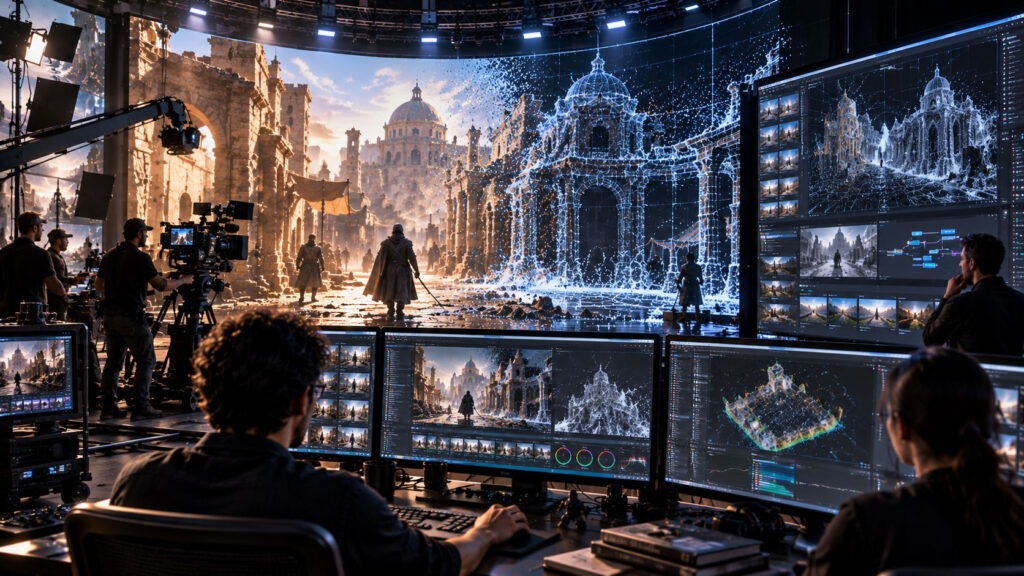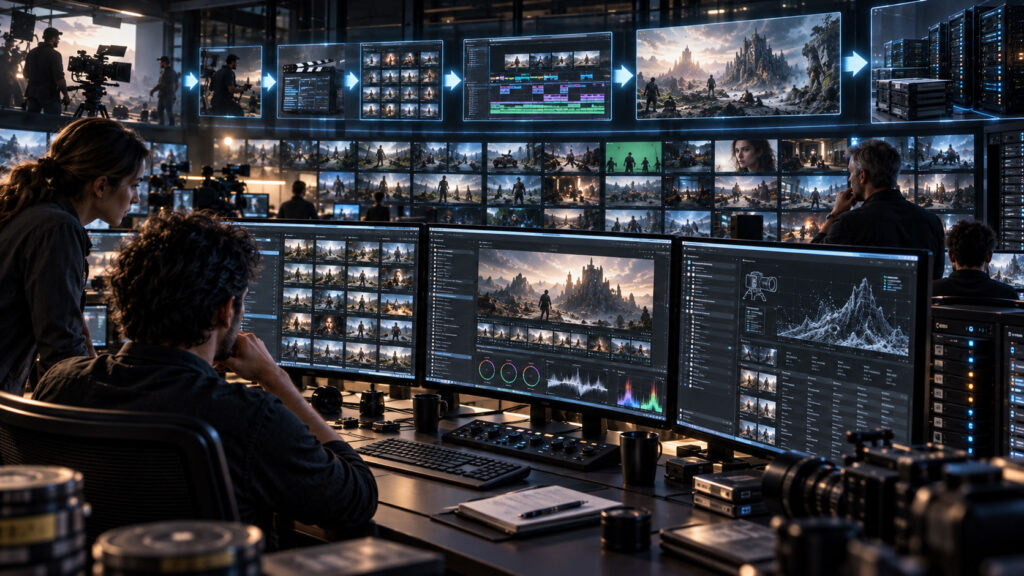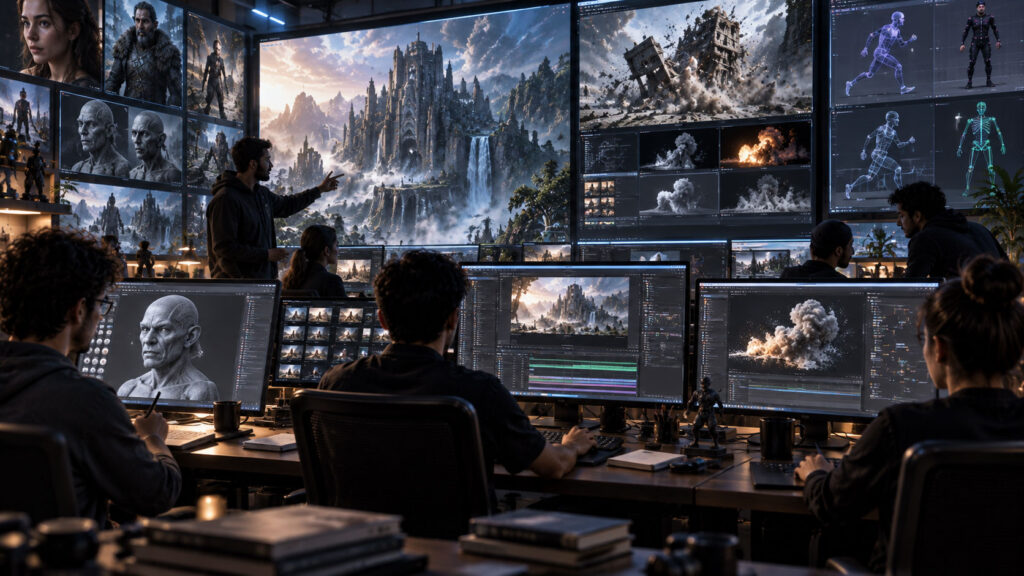
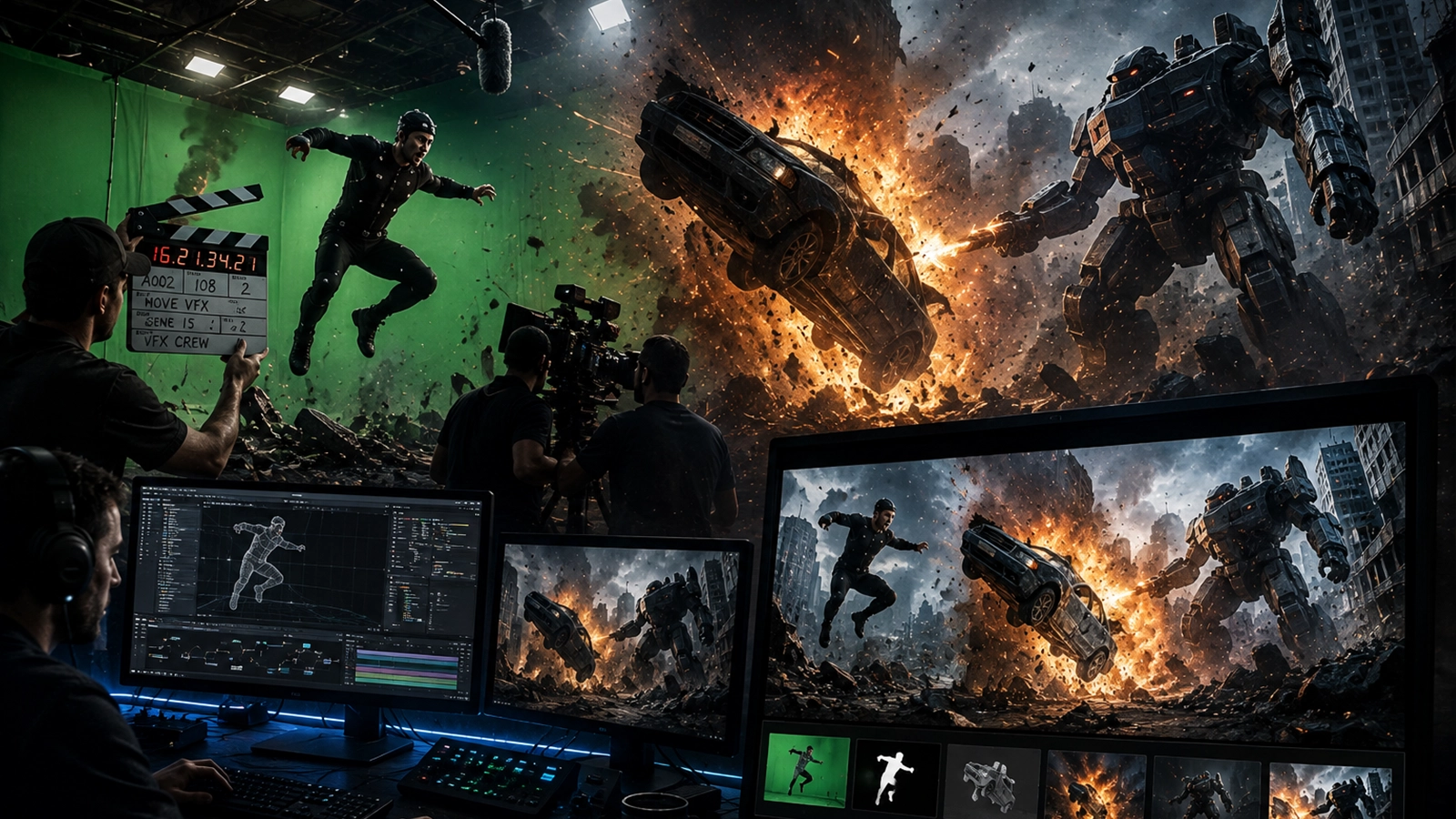
This is the Zgian master guide to AI-powered visual-effects production. It connects concept development, AI video, digital humans, environments, simulation, lighting, tracking, compositing, motion design, editorial, color, sound, QC and delivery into one controlled production pipeline.
🏆 AI VFX 10.0 — The Master Guide
100th major AI/VFX article milestone. This guide connects the major AI VFX pillars into one production framework. Each department has a defined role, handoff and quality gate.
- Why a complete AI VFX pipeline matters
- Concept development
- AI storyboarding
- Previsualization
- AI video generation
- Digital humans
- AI environments
- AI simulation and FX
- AI lighting and look development
- Tracking and match moving
- AI compositing
- AI motion design
- Editorial integration
- Color management
- Sound and music
- Versioning and production management
- Human-in-the-loop review
- Final QC and delivery
- Complete Zgian AI VFX pipeline
- Pipeline checklist
- Final AI VFX QC
1. Why a complete AI VFX pipeline matters
AI VFX becomes production-ready when individual tools are connected into a controlled pipeline. The objective is repeatability: clear inputs, approvals, versioning, handoffs and final-pixel quality.
2. Concept development
Start with story, shot intent, references, audience and technical constraints. AI can expand ideas, but the production team should approve the visual direction before asset creation begins.
3. AI storyboarding
AI-assisted storyboards can explore composition, camera angles and visual continuity quickly. Treat them as planning tools and lock approved shot intent before production.
4. Previsualization
Previs tests camera, blocking, timing and scene relationships before expensive final work. AI-generated material should support the previs objective rather than replace shot planning.
5. AI video generation
Use AI video for concept exploration, plate creation, transitions or selected final shots according to the project’s requirements. Preserve shot IDs and generation metadata.
6. Digital humans
Digital-human work combines identity, facial animation, lip sync, skin, hair and compositing. Lock character references early so identity remains consistent across shots.
7. AI environments
Build environments from macro composition to detailed assets. Combine AI concept generation with procedural systems and controlled asset libraries for continuity and scale.
8. AI simulation and FX
Destruction, fire, smoke, water and particles should be driven by physical and artistic constraints. AI can assist with exploration, prediction, enhancement or variation.
9. AI lighting and look development
Establish a consistent lighting reference, color pipeline and exposure before relighting or look exploration. AI variations must preserve believable light direction and material response.
10. Tracking and match moving
Track the plate before placing CG or AI-generated elements into the scene. Camera, object, lens and scale information must be consistent across departments.
11. AI compositing
Combine mattes, generated elements, CG, atmosphere and photographed plates through controlled keying, edge processing, color matching, depth integration and grain.
12. AI motion design
Titles, logos, kinetic type and broadcast graphics should follow a consistent design system. AI can explore variations while typography and communication remain the priority.
13. Editorial integration
Editorial determines the final rhythm of shots and identifies where VFX changes are required. Track shot versions and frame ranges so departments always work on the correct cut.
14. Color management
Use a predictable color workflow across generated imagery, plates, CG and VFX. Final look development should happen after technical consistency is established.
15. Sound and music
Sound design, dialogue, music and effects influence the perceived impact of AI-generated visuals. Editorial and VFX reviews should account for the final audio context.
16. Versioning and production management
Every AI shot should retain source references, model/tool information where appropriate, prompt or generation settings, version number, artist changes and approval status.
17. Human-in-the-loop review
AI output should pass structured human review for story, identity, continuity, anatomy, physics, copyright or rights constraints, visual quality and technical delivery.
18. Final QC and delivery
Final QC checks the complete sequence at delivery resolution and frame rate. Review image quality, continuity, audio, captions, color, compression and file specifications.
19. Complete Zgian AI VFX pipeline
The complete workflow connects every previous pillar into one repeatable system, with approval gates between creative generation, technical VFX, editorial and delivery.
20. Pipeline checklist
Before final delivery, confirm every shot has an approved source, correct version, stable identity and continuity, valid tracking, integrated compositing, final color, sound, QC status and delivery metadata.
21. Final AI VFX QC
The final image should be judged as one complete production result, not as separate AI, CG, VFX or editorial parts. Review story, visual continuity, technical quality and final delivery compliance.
AI VFX Master Pipeline
↓
02 STORYBOARD / PREVIS
↓
03 AI VIDEO / PLATES
↓
04 DIGITAL HUMANS
↓
05 ENVIRONMENTS
↓
06 SIMULATION & FX
↓
07 LIGHTING
↓
08 TRACKING / MATCH MOVE
↓
09 COMPOSITING
↓
10 MOTION DESIGN
↓
11 EDITORIAL
↓
12 COLOR
↓
13 SOUND
↓
14 FINAL QC
↓
15 DELIVERY
How this fits the Zgian AI VFX series
AI VFX 2.0 → Video Transformation
AI VFX 3.0 → Digital Humans
AI VFX 4.0 → Environment Generation
AI VFX 5.0 → Simulation & FX
AI VFX 6.0 → Lighting & Look Development
AI VFX 7.0 → Compositing
AI VFX 8.0 → Tracking & Match Moving
AI VFX 9.0 → Motion Design
AI VFX 10.0 → this master guide
Frequently asked questions
What is the complete AI VFX pipeline?
It is the controlled workflow from concept and previs through AI generation, assets, tracking, simulation, lighting, compositing, editorial, color, sound, QC and final delivery.
Should AI replace traditional VFX departments?
No. AI can accelerate many tasks, while established VFX disciplines provide control, continuity, physical plausibility, technical reliability and final-pixel quality.
Where should human review happen?
At every major gate: concept approval, generation selection, character and environment continuity, tracking, simulation, compositing, editorial, color and final QC.
Why is version control important for AI VFX?
Generative results can vary. Recording source material, versions and relevant generation settings makes approved shots reproducible and traceable.
What is the final-pixel principle?
Every department should judge its work as part of the complete shot. The final image must work as one coherent result, not merely as a collection of technically successful layers.